Wireless microphones
Best Handheld Wireless Microphones for Worship
Quick answer
Most worship teams should buy the Shure BLX24/SM58 at $389.00 per channel. On a loud platform with floor wedges, step up to the supercardioid Beta 58A capsule on the BLX24R/B58 at $539.00, which buys roughly 5.7 dB of gain before feedback against an omnidirectional capsule.
A handheld wireless microphone for worship has a harder job than a preaching channel. It sits in front of a wedge, next to a drummer, held by somebody who also plays an instrument and who will occasionally cup the grille, and it has to hold its own in a mix rather than merely be intelligible. That makes the capsule choice matter more than the transmitter, and the polar pattern matter more than anything printed on the box. Work out how many channels you can legally fit at your address with the wireless channel calculator first, then choose capsules. Every figure below is researched from published manufacturer specifications and from the standard published values for each polar pattern.
On this page
- Which capsule pattern for your platform volume?
- The two habits that undo any capsule you buy
- Small church: the first handheld channel, $329 to $349
- Mid-size church: worship vocals on a real platform, $389 to $659
- Large room or multi-campus: $699 to $769 per channel
- The handheld systems compared
- What usually goes wrong with worship handhelds
Which capsule pattern for your platform volume?
Gain before feedback on a worship vocal is decided by the polar pattern far more than by the price of the system. The figures below are the standard published values for each pattern: the distance factor is how much further from the source the microphone can sit for the same ratio of direct to reverberant sound, and the gain figure is the improvement over an omnidirectional capsule in the same position. They are the reason a supercardioid earns its money on a loud platform and wastes it in a quiet one.
A supercardioid handheld buys about 5.7 dB of gain before feedback against an omnidirectional capsule and roughly 1 dB over a cardioid, which on a platform with wedges is the difference between a vocal that sits up and one that rings.
| Pattern | Where it rejects most | Distance factor | Gain before feedback vs omni | Catalog system |
|---|---|---|---|---|
| Omnidirectional | Nowhere, equal in all directions | 1.0 | Reference | Lavalier capsules, never a worship vocal |
| Cardioid | Directly behind, at 180 degrees | 1.7 | About 4.8 dB | Shure BLX24/SM58 |
| Supercardioid | Two nulls near 126 degrees | 1.9 | About 5.7 dB | Shure BLX24R/B58 with the Beta 58A capsule |
| Hypercardioid | Two nulls near 110 degrees | 2.0 | About 6.0 dB | Wired handhelds such as the Audix OM5 |
| Cardioid condenser | Directly behind, with far more detail | 1.7 | About 4.8 dB, and less forgiving | Audio-Technica ATW-3212/C710 |
Distance factor and gain figures are the standard published values for each polar pattern rather than measurements of a specific microphone. A supercardioid and a hypercardioid have rear lobes, so a wedge placed directly behind the singer feeds back more readily on those patterns than on a cardioid: aim the wedges at the nulls, roughly 126 degrees off axis for a supercardioid, not straight up the back of the microphone.
The two habits that undo any capsule you buy
Cupping the grille. A hand wrapped around the basket of a handheld microphone blocks the rear ports that create the directional pattern, which turns a supercardioid into something close to an omnidirectional capsule and simultaneously produces a boxy resonance. Every decibel of rejection you paid for disappears in that one grip, and it is the most common cause of a vocal microphone that suddenly rings on one singer and not another. It is a coaching problem rather than an equipment problem.
Working distance. Every singer who backs off from a handheld by six inches loses roughly 6 dB, which the operator then adds back as gain, which the room hands back as feedback. A vocalist an inch from the grille is easy to mix and hard to feed back. Teach the platform team those two things and a $389 system outperforms a $769 one used badly. The wider argument about stage volume is in reducing stage volume in church, and the capsule comparison itself in SM58 versus Beta 58A.
Small church: the first handheld channel, $329 to $349
One or two handheld channels, usually a worship leader and something that can be passed to whoever is speaking next. At this size range and channel count are non-problems, so buy for reliability and for an upgrade path rather than for specifications you will never reach. A single system from a manufacturer with a service network beats a four pack of unbranded transmitters every time, because the failure mode of cheap wireless is silence during a service rather than merely poor sound.
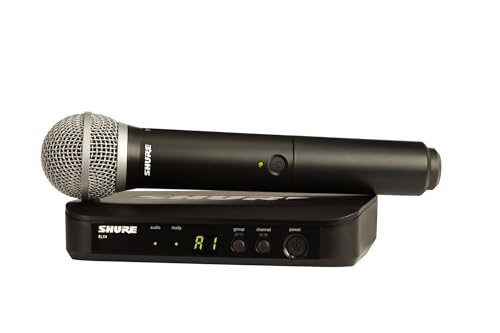
Shure BLX24/PG58 Wireless Vocal Microphone System - H10 Band
$329.00 Specs and sizingThe cheapest Shure system worth putting on a platform. The PG58 capsule is the compromise, and the BLX4 receiver underneath it is identical to the one in the more expensive system, so upgrading later costs a capsule rather than a channel.
Best for: A first worship vocal or a roaming handheld in a room under 250 seats
Check price on Amazon
Sennheiser Pro Audio XSW 1-825-A Vocal Wireless Microphone, A Range 548-572 MHz, Black, medium
$329.00 Specs and sizingOne button finds a clear frequency and syncs the transmitter to it, with a 24 MHz tuning range and ten compatible channels. There is almost no way for a volunteer to set it up wrongly.
Best for: A church with nobody on the rota who wants to learn frequency coordination
Check price on Amazon
Audio-Technica ATW-1102 Wireless Handheld Microphone System
$349.95 Specs and sizingA 2.4 GHz digital system with automatic frequency selection, so the TV band and every future auction are somebody else’s problem. The trade is about 100 feet of range and sharing the band with the building Wi-Fi.
Best for: Small rooms where the network is under your own control
Check price on AmazonWho should not buy this tier: A loud platform with floor wedges and a full band, where the capsule pattern rather than the price is what limits how loud the vocal can go.
Mid-size church: worship vocals on a real platform, $389 to $659
Three to six channels, a band, and wedges. This is where capsule choice starts to pay, and where the honest recommendation splits: a cardioid SM58 for most vocals, and a supercardioid Beta 58A for the lead vocal that has to sit on top of a loud platform. Buy the rack mounting version if the system is permanent, because a receiver on a shelf with its antennas against a wall is where mysterious range complaints come from.

Shure BLX24/SM58 Wireless Microphone System - 14-Hour Battery Life, 300 ft Range, UHF
$389.00 Specs and sizingThe default worship vocal. Twelve compatible channels, a capsule every guest musician already knows, and enough service history that spare parts are never a question.
Best for: Worship vocals in a 100 to 500 seat room
Check price on Amazon
Shure BLX24R/B58 Rack-Mount Wireless Audio System J11 Band (596–620 MHz) – BLX4R Receiver, BLX2 Transmitter with Beta 58A Mic, Up to 14 Hr Battery, 300 ft Range
$539.00 Specs and sizingThe rack mounting BLX receiver with the supercardioid Beta 58A capsule, which buys around 5.7 dB of gain before feedback against an omnidirectional capsule and about 1 dB over the SM58, plus a brighter voicing that cuts through a band.
Check before buying: This J11 unit tunes 596 to 620 MHz, and only the part below 608 MHz is legal to operate in the United States: 608 to 614 MHz is TV channel 37 and 617 MHz upward was sold off in the repack. The system is legal to own and use, but set every frequency below 608 MHz and ignore the top of its range.
Best for: The lead vocal on a platform with floor wedges and a full band
Check price on Amazon
Shure GLXD24+/SM58 Digital Wireless Vocal System - Z3 Band
$659.00 Specs and sizingDual band 2.4 and 5.8 GHz with automatic frequency management and a rechargeable battery, so there is no UHF plan to maintain. Range of about 100 feet and shared spectrum with the church network are the trade.
Best for: A small to mid-size room with nobody to coordinate UHF frequencies
Check price on AmazonWho should not buy this tier: Churches running eight or more transmitters at once, where analog channel spacing wastes spectrum that is not there to waste.
Large room or multi-campus: $699 to $769 per channel
Past roughly six simultaneous transmitters the constraint stops being money and becomes megahertz, and digital transmission is what makes a dense system physically possible. The second reason to be here is a difficult radio environment: a building near a broadcast tower, or a downtown site where every open frequency is already spoken for. Tuning range is the specification that solves that, and it is the one nobody looks at until the system will not scan clean.

Shure SLXD24/SM58 Digital Wireless Microphone System - Includes SLXD2 Handheld Transmitter with SM58 Vocal Mic Capsule and SLXD4 Single Channel Rack Mount Receiver
$769.00 Specs and sizing24 bit digital transmission with much tighter channel spacing than analog, which is what makes a ten channel system fit in the spectrum a church actually has left.
Best for: Churches running more than about six wireless channels at once
Check price on Amazon
Sennheiser Pro Audio EW-D 835-S Wireless Handheld Microphone System, R1-R6
$699.00 Specs and sizingDigital with a 56 MHz tuning range, 134 dB of input dynamic range and no compander, which means no transmitter gain control for a volunteer to set wrong. With a rotating team that is worth more than a specification sheet suggests.
Best for: A system nobody has time to teach, in a crowded radio environment
Check price on Amazon
Audio-Technica 3000 Series Wireless System Wireless Handheld Microphone System (ATW-3212/C710DE2)
$699.00 Specs and sizingA 3000 series receiver with a C710 condenser capsule, which is far more detailed than any dynamic and correspondingly less forgiving of a loud platform and a singer who moves.
Best for: A skilled lead vocalist in a room using in-ear monitors rather than wedges
Check price on AmazonWho should not buy this tier: A church running four channels in a quiet market with a modest platform volume. You would be paying for spectral efficiency and tuning range you have no use for, and at the back of a 200 seat room the audible difference against a BLX system is nil. Spend it on monitoring or on treating the room instead.
The handheld systems compared
What usually goes wrong with worship handhelds
Batteries, first and always. A transmitter rated at 14 hours does not last four Sundays of services plus rehearsals, and no volunteer wants to be the one who guessed wrong. Give one person the job, or move to rechargeable packs, and run your own schedule through the wireless battery calculator so the annual cost is a budget line rather than a surprise.
Then antennas. Receiver antennas need line of sight to the platform, and a tidy rack with the door closed over them costs range for no reason. Keep them clear of metal, of network switches and of power supplies. Then the hand over the antenna: on a handheld transmitter the antenna is in the base of the body, and a grip that covers it shortens range noticeably. Finally, frequency drift in the plan, which happens when a visiting band arrives with their own systems and nobody coordinates. Write the assignments on a card inside the rack door and check them against how to coordinate wireless frequencies whenever guests bring equipment. For the position itself see the worship leader position and the roaming handheld.
How we chose
We did not test these products in person and we never claim to. Picks are researched from manufacturer specification sheets and operator manuals, FCC rules where spectrum is involved, published standards, warranty terms, and the recurring themes in verified owner reviews. Every pick is matched to a real room size, seat count or input list rather than to a price bracket, and it is placed in the tier where its capability actually belongs. Where a product is wrong for most churches we say so on the page.
Sources
- FCC rules on wireless microphone operation after the 600 MHz incentive auction
- Shure published specifications for the BLX, GLXD+ and SLXD platforms and the SM58 and Beta 58A capsules
- Sennheiser published specifications for the XSW 1 and EW-D platforms
- Audio-Technica published specifications for the System 10 and 3000 Series
- Standard published distance factor and gain before feedback values for cardioid, supercardioid and hypercardioid patterns
Frequently asked questions
What handheld wireless microphone should a worship team buy?
The Shure BLX24/SM58 at $389.00 for most churches. It offers up to twelve compatible channels, 300 feet of range, 14 hours of battery life, and a capsule every visiting musician already knows. On a loud platform with floor wedges, step up to the supercardioid Beta 58A capsule on the BLX24R/B58 for roughly one more decibel of gain before feedback and a brighter voicing.
Is a supercardioid microphone better for worship vocals?
On a loud platform, yes. A supercardioid capsule provides about 5.7 dB of gain before feedback against an omnidirectional capsule, against roughly 4.8 dB for a cardioid. The catch is that it has rear lobes rather than a single rear null, so floor wedges must be aimed at roughly 126 degrees off axis rather than directly behind the singer, or the advantage disappears.
Why does one singer make the microphone feed back and another does not?
Usually because one of them cups the grille. A hand wrapped around the basket blocks the rear ports that create the directional pattern, which turns a supercardioid into something close to omnidirectional and adds a boxy resonance. Working distance is the other cause: backing off six inches costs about 6 dB, which the operator adds back as gain and the room returns as feedback.
Should worship vocals use a condenser or a dynamic handheld?
Dynamic, in almost every church. A condenser capsule is more detailed and more sensitive, which means it also picks up more of the platform, more of the wedges and every inconsistency in technique. Condensers make sense where the platform uses in-ear monitors instead of wedges and the vocalist has consistent microphone technique, which describes a minority of church platforms.
How many handheld wireless channels can a church run at once?
An analog system such as the BLX supports up to twelve compatible channels within one band, but the practical limit is set by the TV stations near your building rather than by the manufacturer. In a crowded market you may fit only six. Digital systems space channels more tightly, which is the main reason to pay for them once the count climbs past about six.
Is it legal to use a secondhand wireless microphone in the United States?
Only if it tunes to a legal band. Operating in 617 to 652 MHz or 663 to 698 MHz is prohibited because that spectrum was auctioned to mobile carriers, and the 698 to 806 MHz band has been closed since 2010. The band letter on the receiver tells you the tuning range, and no firmware update can move a system out of a prohibited band.
Researched, not professional advice. This page is compiled from published manufacturer specifications, operator manuals, FCC rules, published standards and owner-review consensus, not hands-on testing. Sound system design, rigging loudspeakers overhead, and any electrical work are jobs for a qualified professional: have flown loudspeakers and their attachment points signed off by a structural engineer or a certified rigger, and have all wiring done by a licensed electrician to your local code. Wireless microphone rules change, so confirm the current FCC position before buying. As an Amazon Associate we earn from qualifying purchases.