Wireless and monitors
Wireless Battery Budget Calculator
Quick answer
Six wireless transmitters running three services a week need 12 rechargeable packs total, six always in service and six always on the charger. Left on disposable AA cells instead, the same six transmitters burn through 1,872 cells a year, about $936 at 50 cents a cell.
The battery question in church audio is rarely about which brand of AA cell to buy. It is about how many packs actually exist, because a wireless transmitter with a charged pack in the drawer and a dead one still on the belt is functionally the same as a wireless transmitter with no batteries at all.
Enter your transmitter count and service schedule below. It returns the rechargeable pack count that keeps every position covered every week, and the cost of running the same fleet on disposable alkaline cells instead, so the two options can be compared honestly.
Wireless battery calculator
Rechargeable packs needed
Rechargeable wireless systems and spares
Top matches update when you change your numbers.

Shure SLXD24/SM58 Digital Wireless Microphone System - Includes SLXD2 Handheld Transmitter with SM58 Vocal Mic Capsule and SLXD4 Single Channel Rack Mount Receiver
$769.00 Specs and sizingDigital transmission with 24 bit audio and far tighter channel spacing than analog, so many more systems fit in the shrinking legal spectrum. That density is the reason to pay the difference.
Best for: Churches running more than about six wireless channels at once
Check price on Amazon
Shure SLXD24D/SM58 Dual Wireless Vocal System - H55 Band
$1,649.00 Specs and sizingTwo SLXD channels in one rack unit, with the receivers coordinating their own frequencies. Two channels per rack unit is what makes a ten channel system physically possible.
Best for: Dense wireless systems where rack space and coordination time both matter
Check price on Amazon
Shure GLXD24+/SM58 Digital Wireless Vocal System - Z3 Band
$659.00 Specs and sizingDual band 2.4 and 5.8 GHz with automatic frequency management and a rechargeable battery, so there is no UHF coordination to do at all. The trade is range and the fact that it shares the band with the church Wi-Fi.
Best for: Small rooms with no volunteer willing to coordinate UHF frequencies
Check price on Amazon
Sennheiser Pro Audio EW-D 835-S Wireless Handheld Microphone System, R1-R6
$699.00 Specs and sizingDigital, with a 56 MHz tuning range, 134 dB of input dynamic range and no compander at all, so there is no gain knob to set wrong. That last point matters with volunteers.
Best for: A system nobody has time to teach: it is very hard to set up badly
Check price on Amazon
Sennheiser EW-D ME2 Lavalier SET (R4-9)
$737.40 Specs and sizingThe EW-D bodypack with the ME2 omnidirectional lavalier, and the same no-gain-setting advantage as the handheld.
Best for: A lapel channel that has to work every week without anyone checking it
Check price on Amazon
Sennheiser EW-D ME3 Dynamic Headset SET (R1-6)
$669.86 Specs and sizingA cardioid headworn capsule on the EW-D platform. The directional pattern plus the fixed mouth distance is the most feedback-resistant combination a preacher can wear.
Best for: The hardest rooms: high ceilings, hard surfaces and a wireless preaching microphone
Check price on Amazon
Shure BLX24/SM58 Wireless Microphone System - 14-Hour Battery Life, 300 ft Range, UHF
$389.00 Specs and sizingThe SM58 capsule on a BLX transmitter, which is the wireless most churches settle on. Up to twelve compatible channels per band, and the capsule is the one every singer already knows how to use.
Best for: Worship vocals and a roaming handheld in a 100 to 500 seat room
Check price on Amazon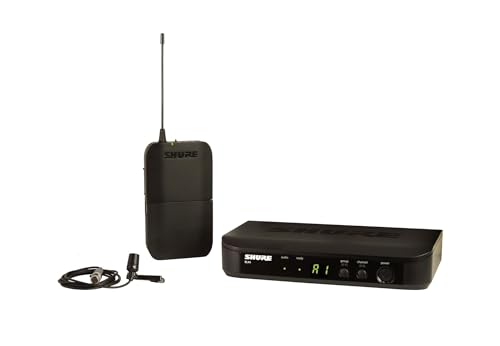
Shure BLX14/CVL Lavalier Audio System H9 Band (512–542 MHz) – BLX4 Receiver, BLX1 Bodypack & CVL Clip-On Lavalier Mic, Up to 14 Hr Battery, 300 ft Range
$359.00 Specs and sizingThe standard church lapel system. An omnidirectional lavalier is forgiving of head movement and unforgiving of feedback, which is why placement and gain structure matter more here than anywhere else.
Best for: A preacher who wants nothing visible on the face
Check price on Amazon
Shure BLX14/P31 Wireless Headset Microphone System - H10 Band
$379.00 Specs and sizingA headworn system, and the honest recommendation over a lapel for most preaching: the capsule stays a fixed distance from the mouth, which is worth roughly 6 to 10 dB of usable gain.
Best for: Preaching, especially in a live room or where the lapel keeps feeding back
Check price on Amazon
Shure Centraverse CVL Lavalier Condenser Microphone
$54.00A spare lavalier capsule for a BLX bodypack. Buying a second capsule is far cheaper than a second system, and a dead capsule is the most common wireless failure.
Best for: The spare that lives in the drawer
Check price on Amazon
Audio-Technica ATW-1102 Wireless Handheld Microphone System
$349.95 Specs and sizingA 2.4 GHz digital system with automatic frequency selection and three levels of diversity. No UHF licence question at all, because it is not in the TV band.
Best for: Churches that want nothing to do with the 600 MHz repack
Check price on AmazonOn this page
How many battery packs does a wireless system need?
Two packs per transmitter, not one:
total packs = transmitters * 2
One pack lives in the transmitter and one lives on the charger, at all times, for every channel in regular use. This is not a spare-parts margin, it is the operating model: a pack that finished a rehearsal on Wednesday needs the whole gap until Sunday to recharge, and a system with only as many packs as transmitters means somebody is guessing whether Sunday's pack is actually full.
Charging cadence follows from the service schedule:
weekly hours = services per week * hours per servicecharges per week = ceil( weekly hours / pack runtime hours )
A typical eight hour rechargeable pack covers a Sunday service and a midweek rehearsal on one charge in many churches, and needs two charge cycles a week once a second rehearsal or a longer service pushes weekly runtime past eight hours.
Rechargeable packs and alkaline cost by transmitter count
At three services a week and three hours each, which is a typical Sunday plus a midweek rehearsal, for a range of fleet sizes.
Six wireless transmitters need 12 rechargeable packs and would otherwise burn through 1,872 AA cells a year, about $936 at 50 cents a cell, and a ten channel system nearly doubles both figures.
| Transmitters | Rechargeable packs needed | Alkaline cells per year | Alkaline cost per year |
|---|---|---|---|
| 2 | 4 | 624 | $312 |
| 4 | 8 | 1,248 | $624 |
| 6 | 12 | 1,872 | $936 |
| 8 | 16 | 2,496 | $1,248 |
| 10 | 20 | 3,120 | $1,560 |
| 12 | 24 | 3,744 | $1,872 |
Alkaline cost assumes two AA cells per transmitter per service and a typical bulk price of 50 cents a cell. Lithium disposables last longer per cell but cost more per cell, and the comparison to rechargeable packs comes out similarly either way.
How often do rechargeable packs need charging?
Six transmitters and eight hour packs, at six different service schedules. Weekly runtime is what decides charging frequency, not the transmitter count.
A single Sunday service needs only one charge cycle a week on an eight hour pack, and adding a second rehearsal pushes weekly runtime past eight hours and requires two charge cycles instead.
| Services per week | Hours per service | Weekly runtime | Charges per week |
|---|---|---|---|
| 1 | 1 hr | 1 hr | 1 |
| 1 | 2 hr | 2 hr | 1 |
| 2 | 2 hr | 4 hr | 1 |
| 3 | 2 hr | 6 hr | 1 |
| 3 | 3 hr | 9 hr | 2 |
| 4 | 3 hr | 12 hr | 2 |
Charges per week is the same regardless of how many transmitters are in service, because every pack follows the same weekly runtime independently. What scales with transmitter count is how many packs and chargers are needed, not how often each one charges.
Rechargeable packs against disposable alkaline cells
The arithmetic almost always favors rechargeable once a system passes about four active channels, and the reasons beyond cost matter more in practice. A dead AA cell mid-service means walking a transmitter to a volunteer's pocket for a swap; a properly maintained rechargeable system means every pack on the charger overnight is provably full before anyone opens the building. Digital systems such as the Shure SLXD24/SM58 Digital Wireless Microphone System - Includes SLXD2 Handheld Transmitter with SM58 Vocal Mic Capsule and SLXD4 Single Channel Rack Mount Receiver or the Sennheiser Pro Audio EW-D 835-S Wireless Handheld Microphone System, R1-R6 ship with rechargeable packs and a charging dock as standard, which removes the guesswork about whether a given pack has actually been charged.
Where a system still runs on disposable AA cells, standardize on a single cell type across the building, buy in bulk, and put a battery check on the pre-service checklist rather than trusting a runtime estimate on the transmitter's own meter, which is frequently optimistic.
What happens if a wireless microphone dies mid-service?
It happens to every church eventually, and the fix is process rather than hardware. Keep one spare charged pack per four channels in service, which is the same convention used for spare transmitters generally, and assign one person the job of checking every pack before the doors open rather than assuming the team member who used it last did. A dead capsule and a dead battery look identical from the platform; carrying a spare capsule such as the Shure Centraverse CVL Lavalier Condenser Microphone alongside spare packs covers both failure modes with one habit.
Plan the channel count itself with the wireless microphone channel calculator, since battery planning only matters once the channel count and spectrum are settled.
Frequently asked questions
How many battery packs do I need per wireless transmitter?
Two: one in the transmitter and one on the charger, for every channel in regular use. This is the working model, not a spare-parts margin, because a pack that finished Wednesday rehearsal needs until Sunday to fully recharge. Six wireless transmitters need 12 rechargeable packs total to keep every position genuinely covered every week without guessing which pack is actually full.
How much do disposable batteries cost a church with wireless microphones?
For six transmitters running a typical Sunday plus a midweek rehearsal, about 1,872 AA cells a year at two cells per transmitter per service, roughly $936 at a bulk price of 50 cents a cell. That number scales directly with transmitter count and service frequency, and it is the ongoing cost that rechargeable packs replace with a one-time equipment purchase.
Are rechargeable batteries worth it for church wireless microphones?
Usually yes above about four active channels, both on cost and on reliability. The yearly alkaline spend on a modest system often exceeds what a rechargeable charging dock costs within two to three years, and a properly maintained rechargeable system removes the guesswork about whether a given pack is actually charged, which a drawer full of used AA cells does not.
How often do rechargeable wireless mic packs need charging?
It depends on total weekly runtime, not on how many transmitters you have. An eight hour pack covers a single Sunday service on one charge, but adding a midweek rehearsal usually pushes weekly runtime past eight hours and requires two charge cycles a week instead. Every pack follows this schedule independently, whether the system has two transmitters or twelve.
What should I do if a wireless microphone battery dies during a service?
Have a spare charged pack ready, at roughly one spare per four channels in service, and assign one person to check every pack before the doors open rather than trusting a runtime meter on the transmitter, which is often optimistic. Treat a dead battery the same way as a dead capsule: something to catch before the service starts, not during it.
Should every wireless transmitter use the same battery type?
Yes, wherever possible. Standardizing on one rechargeable pack type or one disposable cell size across the whole building means one charging dock, one bulk order and one habit for the volunteer checking batteries before a service, rather than several incompatible systems each with their own quirks and their own drawer of chargers.
Researched, not professional advice. This page is compiled from published manufacturer specifications, operator manuals, FCC rules, published standards and owner-review consensus, not hands-on testing. Sound system design, rigging loudspeakers overhead, and any electrical work are jobs for a qualified professional: have flown loudspeakers and their attachment points signed off by a structural engineer or a certified rigger, and have all wiring done by a licensed electrician to your local code. Wireless microphone rules change, so confirm the current FCC position before buying. As an Amazon Associate we earn from qualifying purchases.