Speaking positions
Microphone for a Roaming Handheld
Quick answer
Use a cardioid or supercardioid dynamic wireless handheld for a roaming channel. It is the one microphone that walks into the loudspeaker coverage on purpose, so pattern and a disciplined hand matter more than capsule quality or transmitter price. Buy a second channel as a spare.
The roaming handheld does testimonies, interviews, announcements and the children talk, and it is the only microphone in the building that deliberately goes where the loudspeakers are pointing. That single fact should drive every decision about it. It also gets handed to people who have never held a microphone, which means it needs to be forgiving of bad technique while still rejecting the room. A dynamic capsule in a directional pattern on a reliable wireless platform is the answer, and the reliability matters because this channel is passed between strangers mid-service.
On this page
Where in the room the microphone actually goes
Map the journey before you choose anything. A handheld that never leaves the platform is an easy channel. One that goes to the third row on the outside aisle is standing underneath a loudspeaker, and one that goes to the balcony is at the edge of its radio range as well.
The front rows on the outside aisles are the highest risk position in the room, because they sit directly under the main loudspeaker coverage.
| Where it goes | Feedback risk | Radio risk | What to do about it |
|---|---|---|---|
| On the platform, behind the speakers | Low | Low | Nothing. This is the easy case. |
| Front rows, centre aisle | Moderate | Low | Keep the capsule pointed at the mouth, not held low |
| Front rows, outside aisles | High | Low | Directional capsule, and check the speaker aiming |
| Mid room | Moderate | Low | Usually fine. Watch any delay or fill speakers overhead. |
| Back of the room or balcony | Low | High | Receiver antennas need line of sight. Consider a second receiver position. |
| Foyer or overflow | Low | Very high | Usually out of range. Plan a separate solution. |
Under-balcony and delay fill loudspeakers are the forgotten hazard, because they are close to head height and often directly above the aisle a roaming microphone uses.
Which capsule, and what to buy
Dynamic rather than condenser, because a handheld gets dropped, breathed on and gripped over the grille. Directional rather than omnidirectional, because it is going into the loudspeaker coverage. Beyond that, the capsule everyone recognises is worth something in itself: a visiting speaker who has used an SM58 before knows instinctively how to hold it.

Shure BLX24/SM58 Wireless Microphone System - 14-Hour Battery Life, 300 ft Range, UHF
$389.00 Specs and sizingThe SM58 capsule on a BLX transmitter, which is the wireless most churches settle on. Up to twelve compatible channels per band, and a capsule every visiting musician and speaker already understands.
Best for: A roaming handheld in a 100 to 500 seat room
Check price on Amazon
Shure BLX24R/B58 Rack-Mount Wireless Audio System J11 Band (596–620 MHz) – BLX4R Receiver, BLX2 Transmitter with Beta 58A Mic, Up to 14 Hr Battery, 300 ft Range
$539.00 Specs and sizingA rack-mounting receiver with the Beta 58A capsule, whose tighter supercardioid pattern buys real gain before feedback when the handheld has to work near the loudspeakers.
Check before buying: This J11 unit tunes 596 to 620 MHz, and only the part below 608 MHz is legal to operate in the United States: 608 to 614 MHz is TV channel 37 and 617 MHz upward was sold off in the repack. The system is legal to own and use, but set every frequency below 608 MHz and ignore the top of its range.
Best for: A permanent rack install in a room where the handheld rings
Check price on Amazon
Sennheiser Pro Audio XSW 1-825 DUAL-A Channel Wireless Microphone System
$649.00 Specs and sizingTwo channels in one receiver at close to the price of one and a half, which is the cheapest honest way to have a second handheld ready rather than passing one microphone around.
Best for: Interviews, or a handheld plus a guaranteed spare
Check price on Amazon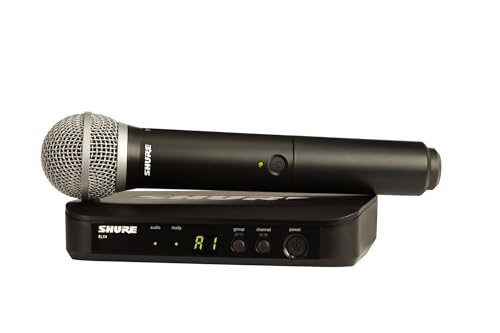
Shure BLX24/PG58 Wireless Vocal Microphone System - H10 Band
$329.00 Specs and sizingThe cheapest Shure wireless worth putting in a sanctuary, on the same receiver as the more expensive versions, so upgrading the capsule later costs a capsule rather than a channel.
Best for: A first wireless handheld for announcements
Check price on AmazonHow many roaming channels does a church need?
One, plus a spare, covers most churches. The spare is not a luxury: this is the channel most likely to fail in front of everyone, because it is handled by people who do not know where the mute switch is and it runs on batteries somebody else was supposed to change. A dual receiver gives you two channels in one rack space and one power outlet, which is usually the right purchase over a second standalone system.
Two live roaming channels become genuinely useful once you do interviews, baptism testimonies or anything where two people speak in turn away from the platform. Beyond two, ask hard whether the positions really move, because every wireless channel costs two to six times the equivalent wired channel over its life once batteries are counted. Work the total out in the wireless microphone channel calculator, and remember that in-ear packs compete for the same spectrum.
Channel setup and technique
This channel is handed to people who have never used a microphone, so the processing has to absorb bad technique. Set it once and make it forgiving.
Compression around 4:1 is heavier than a preaching channel needs, because a roaming handheld is held at wildly varying distances.
| Setting | Starting point | Why |
|---|---|---|
| High pass filter | 100 Hz | Handling noise and proximity boost from a hand gripping the grille |
| Compression | About 4:1, up to 8 dB on peaks | Absorbs the difference between a whisper at arm’s length and a shout at the lips |
| Presence | 3 to 5 kHz, modest | Helps untrained speakers cut through, but it is the first band to ring |
| Narrow notches | One or two if the room rings in the aisles | Found by walking the microphone where it will actually go |
| Mute strategy | Muted at the console by default | Never rely on the transmitter switch. Somebody will find it. |
| Monitor sends | Off | A roaming channel in a wedge is a feedback loop waiting for the aisle |
Ring this channel out by walking it to the seats it will actually visit, not by standing at the console. The feedback frequency in the front row on the outside aisle is not the one you find on the platform.
The gain before feedback problem specific to this position
Every other microphone in the building is behind the loudspeakers. This one walks in front of them, which inverts the usual relationship: as the microphone moves toward the seats, the loudspeaker level at the capsule rises while the voice level stays the same. The margin you set on the platform is gone by the third row.
Three things help and they compound. A supercardioid capsule rejects more of what is in front of it from off axis angles, which is exactly the geometry here. Loudspeakers aimed so their coverage starts at the first row rather than spilling onto the platform edge keep the front rows quieter than they would otherwise be. And teaching the technique takes thirty seconds: hold the capsule close to the mouth, not down at chest height, because a microphone held low is far from the voice and close to the speakers, which is the worst combination available. That one instruction is worth more than any processing.
What usually goes wrong
The transmitter switch, first and always. Somebody finds it, mutes the microphone and hands it to the next person, and thirty seconds of confusion follow. Mute at the console, tape over the switch if the transmitter allows, and make sure the operator knows which fader it is without looking. Second, dead batteries, because this channel is used intermittently and nobody notices it has been on since the rehearsal.
Third, handing the microphone to a person and letting them hold it at chest height, which is a technique problem with a thirty second fix. Fourth, range: the balcony and the foyer are usually outside what the receiver can manage, and the answer is antenna placement rather than a bigger transmitter, since operating power is capped by the FCC rules set out in the legal band list. Get the antennas out of the closed rack and give them line of sight down the room.
How we chose
We did not test these products in person and we never claim to. Picks are researched from manufacturer specification sheets and operator manuals, FCC rules where spectrum is involved, published standards, warranty terms, and the recurring themes in verified owner reviews. Every pick is matched to a real room size, seat count or input list rather than to a price bracket, and it is placed in the tier where its capability actually belongs. Where a product is wrong for most churches we say so on the page.
Sources
- Shure published specifications for the BLX wireless platform and SM58 and Beta 58A capsules
- Sennheiser published specifications for the XSW 1 wireless platform
- FCC guidance for wireless microphone users
Frequently asked questions
What kind of microphone is best for a roaming handheld in church?
A cardioid or supercardioid dynamic on a wireless transmitter. Dynamic because it gets dropped, breathed on and gripped over the grille. Directional because it is the one microphone that deliberately walks into the loudspeaker coverage. A familiar capsule also helps, since a visiting speaker who has held an SM58 before knows how to use it.
Why does the handheld feed back when someone takes it into the congregation?
Because it is moving toward the loudspeakers. The level from the speakers at the capsule rises as it moves out while the voice level stays the same, so the gain margin you set on the platform disappears. A supercardioid capsule, loudspeakers aimed to start at the first row, and holding the microphone close to the mouth all help.
How many wireless handhelds does a church need?
One plus a spare covers most churches, and a dual receiver gives you both in one rack space and one power outlet. Two live channels become genuinely useful once you do interviews or testimonies where people speak in turn. Beyond that, check whether the positions really move before paying for wireless.
Should we tape over the switch on the transmitter?
If the transmitter allows it, yes. A muted handheld passed to the next speaker is one of the most common thirty second failures in a church service. Mute at the console by default instead, make sure the operator knows the fader without looking, and brief anyone receiving the microphone that it is already live.
How should someone hold a handheld microphone?
Close to the mouth, within a few inches, and angled up toward it rather than held flat at chest height. A microphone held low is far from the voice and closer to the loudspeakers, which is the worst possible combination for both level and feedback. Thirty seconds of instruction is worth more than any amount of processing.
Our handheld drops out at the back of the room. What fixes it?
Antenna placement, almost always. Receiver antennas need line of sight to where the microphone travels, and a closed rack door costs range you already paid for. Transmitter power is capped by the FCC rules, so buying a bigger transmitter is not an option. Remote the antennas out of the rack, or move the receiver.
Researched, not professional advice. This page is compiled from published manufacturer specifications, operator manuals, FCC rules, published standards and owner-review consensus, not hands-on testing. Sound system design, rigging loudspeakers overhead, and any electrical work are jobs for a qualified professional: have flown loudspeakers and their attachment points signed off by a structural engineer or a certified rigger, and have all wiring done by a licensed electrician to your local code. Wireless microphone rules change, so confirm the current FCC position before buying. As an Amazon Associate we earn from qualifying purchases.