Wireless microphones
Best Wireless Microphones for Churches
Quick answer
Most churches should buy the Shure BLX24/SM58 at $389 per channel and run no more than four to six analog channels inside 470 to 608 MHz. Past six channels, a digital system such as the SLXD24 fits far more transmitters into the same shrinking legal spectrum.
Wireless is the one part of a church sound system where the wrong purchase can be illegal rather than merely disappointing. The 600 MHz incentive auction took a third of the usable spectrum away from wireless microphones, and equipment tuned to the reallocated bands is now scrap metal no matter how good the deal looks. Before you price anything, work out how many channels you need with the wireless microphone channel calculator, then read which frequencies are legal for your address. Everything below is researched from published manufacturer specifications and the FCC rules, and every band figure in this article is a legal boundary rather than a recommendation.
On this page
- How many wireless channels does a church actually need?
- Small church: two to four channels, under $400 each
- Mid-size church: four to seven channels, $380 to $700 each
- Large room or multi-campus: eight channels and up, $700 to $1,650 per system
- Which frequencies are legal to operate in the United States?
- Analog or digital, and when the extra money is justified
- The systems compared
- What usually goes wrong with church wireless
How many wireless channels does a church actually need?
Channel count is the number that decides your budget, your rack space and whether you can stay analog. Count positions that genuinely move, not positions that could theoretically be wireless. A lectern does not move. A choir does not move. Ask the question again after you have priced it: each wireless channel costs between two and six times what the equivalent wired channel costs, forever, including batteries.
A 250 seat church with a contemporary service typically needs four wireless channels, which analog systems handle comfortably inside the 470 to 608 MHz band.
| Seats | Service style | Wireless channels | What they are | Analog or digital |
|---|---|---|---|---|
| Under 100 | Traditional or blended | 2 | Preacher plus one roaming handheld | Analog is fine |
| 100 to 250 | Blended | 3 to 4 | Preacher, worship leader, two handhelds | Analog is fine |
| 250 to 500 | Contemporary | 5 to 7 | Two speaking, two to three vocals, spares | Digital from about six |
| 500 to 1,000 | Contemporary with a band | 8 to 12 | Speaking, vocals, guitar packs, in-ear packs | Digital, coordinated |
| 1,000 and over | Multi-service or multi-campus | 12 to 20+ | Everything above, plus production talkback | Digital, with a spectrum scan |
In-ear monitor transmitters compete for the same spectrum as microphones and must be counted in the same plan. A church with eight microphone channels and six in-ear packs is coordinating fourteen frequencies, not eight.
Small church: two to four channels, under $400 each
At this size the job is a preaching channel and a handheld that works every week, not a system. Buy fewer channels of better equipment rather than a four pack of unbranded transmitters, because the failure mode of cheap wireless is not bad sound, it is silence at the worst possible moment. If your building has reliable Wi-Fi under your own control, a 2.4 GHz system removes the frequency coordination problem entirely.
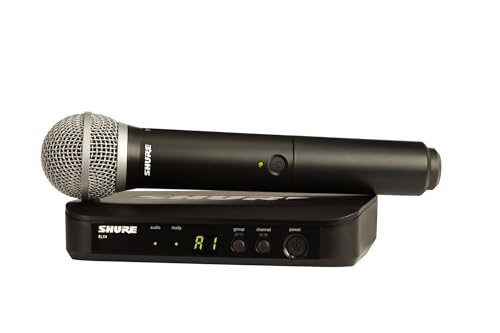
Shure BLX24/PG58 Wireless Vocal Microphone System - H10 Band
$329.00 Specs and sizingThe cheapest Shure wireless worth putting in a sanctuary. The PG58 capsule is a step below the SM58, but the BLX4 receiver is identical to the one in the more expensive system, so upgrading later costs a capsule rather than a whole channel.
Best for: A first wireless handheld for announcements and a roaming speaker
Check price on Amazon
Sennheiser Pro Audio XSW 1-825-A Vocal Wireless Microphone, A Range 548-572 MHz, Black, medium
$329.00 Specs and sizingA 24 MHz tuning range and an automatic frequency setup that finds a clear channel without anyone reading a manual. Ten compatible channels is far more than a small church will ever use.
Best for: A church with no volunteer willing to learn frequency coordination
Check price on Amazon
Audio-Technica ATW-1102 Wireless Handheld Microphone System
$349.95 Specs and sizingA 2.4 GHz digital system, so the 600 MHz repack and every future TV band auction are somebody else’s problem. The trade is about 100 feet of range and sharing the band with the church Wi-Fi.
Best for: Small buildings where the network is under your control
Check price on AmazonWho should not buy this tier: Churches that already run four or more wireless channels, where channel spacing rather than price is the binding constraint.
Mid-size church: four to seven channels, $380 to $700 each
This is where most churches live and where the BLX platform earns its reputation. The decision at this size is capsule and form factor rather than brand: a supercardioid on a loud platform, a headworn rather than a lapel for preaching, and a dual receiver wherever two channels can share one rack space and one power outlet. Plan the frequencies once, write them on a card taped inside the rack door, and do not let anyone change them.

Shure BLX24/SM58 Wireless Microphone System - 14-Hour Battery Life, 300 ft Range, UHF
$389.00 Specs and sizingThe default answer. Twelve compatible channels per band, a capsule every guest musician already knows, and a service history long enough that spare parts are never a question.
Best for: Worship vocals and a roaming handheld in a 100 to 500 seat room
Check price on Amazon
Shure BLX14/P31 Wireless Headset Microphone System - H10 Band
$379.00 Specs and sizingA headworn system, and the honest recommendation over a lapel for almost every preacher. The capsule stays a fixed distance from the mouth, which is worth roughly 6 to 10 dB of usable gain before the system rings.
Best for: Preaching in a live room, or anywhere a lapel keeps feeding back
Check price on Amazon
Shure GLXD24+/SM58 Digital Wireless Vocal System - Z3 Band
$659.00 Specs and sizingDual band 2.4 and 5.8 GHz with automatic frequency management and a rechargeable battery, so there is no UHF plan to maintain at all. Range is about 100 feet and it shares spectrum with the building network.
Best for: Small to mid-size rooms with nobody on the rota to coordinate UHF
Check price on AmazonWho should not buy this tier: Rooms already running eight or more transmitters, where analog channel spacing wastes spectrum you cannot spare.
Large room or multi-campus: eight channels and up, $700 to $1,650 per system
Past roughly six simultaneous transmitters the binding constraint stops being money and becomes megahertz. Digital systems pack channels far closer together than analog can, which is the entire reason to pay the difference. At this size someone must own the frequency plan: scan the spectrum at the building, document every assignment, and re-scan whenever a TV station changes or a neighbouring venue installs its own system.

Shure SLXD24/SM58 Digital Wireless Microphone System - Includes SLXD2 Handheld Transmitter with SM58 Vocal Mic Capsule and SLXD4 Single Channel Rack Mount Receiver
$769.00 Specs and sizing24 bit digital transmission with much tighter channel spacing than analog, which is what makes a ten channel system physically possible in the spectrum you have left.
Best for: Churches running more than about six wireless channels at once
Check price on Amazon
Shure SLXD24D/SM58 Dual Wireless Vocal System - H55 Band
$1,649.00 Specs and sizingTwo SLXD receivers in one rack unit that coordinate their own frequencies. Rack space and coordination time are both real costs once the channel count climbs.
Best for: Dense systems where the rack is already full
Check price on Amazon
Sennheiser Pro Audio Sennheiser EW 100-835S Wireless Dynamic Cardioid Microphone System-A Band (516-558Mhz), 100 G4-835-S-A
$749.00 Specs and sizingA 42 MHz tuning range with a true diversity receiver and a scan function that finds clear frequencies for you. If your building is near a broadcast tower, tuning range is the specification that matters.
Best for: Crowded RF environments and buildings close to TV transmitters
Check price on AmazonWho should not buy this tier: A church running four channels in a quiet market. You would be paying for spectral efficiency you have no use for, and the audible difference over a BLX system at the back of a 200 seat room is nil.
Which frequencies are legal to operate in the United States?
This table is the reason to read a used listing carefully. A system tuned to the 600 MHz service band cannot be re-tuned by a firmware update, it cannot be legally operated, and the manufacturer rebate programmes that once covered it have closed. Secondhand gear in a prohibited band is worthless, and the fact that it still powers up and still passes audio changes nothing.
Only 470 to 608 MHz is a full power working band for church wireless microphones, and 617 to 652 MHz and 663 to 698 MHz are illegal to operate.
| Range | What it is | Status | What it means for a church |
|---|---|---|---|
| 470 to 608 MHz | UHF TV band | Legal | The working band. Open channels depend on the TV stations at your address. |
| 608 to 614 MHz | TV channel 37 | Prohibited | Reserved for radio astronomy and wireless medical telemetry. |
| 614 to 616 MHz | Guard band segment | Legal at 20 mW or less | Enough room for one or two very low power channels, no more. |
| 617 to 652 MHz | 600 MHz downlink | Illegal to operate | Sold to mobile carriers. Transmitting here is an offence. |
| 652 to 663 MHz | Duplex gap | Tightly restricted | Not a band to buy equipment for. |
| 663 to 698 MHz | 600 MHz uplink | Illegal to operate | Sold to mobile carriers. Transmitting here is an offence. |
| 698 to 806 MHz | 700 MHz band | Prohibited since 2010 | Public safety and mobile. Any gear tuned here is scrap. |
| 902 to 928 MHz | ISM | Legal, unlicensed | Shared with cordless phones, telemetry and utility meters. |
| 1920 to 1930 MHz | DECT | Legal, unlicensed | Quiet band, short range, limited product choice. |
| 2400 to 2483.5 MHz | 2.4 GHz ISM | Legal, unlicensed | Shared with every Wi-Fi access point in the building. |
| 5725 to 5875 MHz | 5.8 GHz ISM | Legal, unlicensed | Less crowded than 2.4 GHz, shorter effective range. |
Figures are the FCC allocation after the incentive auction and repack. Open channels inside 470 to 608 MHz vary by location because they depend on the TV stations receivable at your building, so scan on site before you commit.
Analog or digital, and when the extra money is justified
Analog wireless uses a compander, a matched compressor and expander pair, to squeeze audio into the radio channel. It works, it has worked for decades, and at four channels nobody in the congregation could pick it out of a line-up. Digital systems transmit the audio as data, which removes the compander artefacts and, far more importantly, lets channels sit much closer together without intermodulation products landing on each other.
That density is the real purchase. If you are running four channels, digital buys you cleaner sound that no one will notice. If you are running twelve, digital is what makes twelve possible at all. The other honest advantage is that systems such as the EW-D have no gain knob on the transmitter to set wrong, which matters more with a volunteer team than any specification on the box. For the full argument see analog versus digital wireless and BLX versus SLXD.
The systems compared
| Model | Price | Frequency band | Transmitter type | Microphone type | Polar pattern | Battery life | Rated range |
|---|---|---|---|---|---|---|---|
| Shure BLX24/PG58 Wireless Vocal Microphone System - H10 Band | $329.00 | UHF | Handheld | Dynamic | Cardioid | 14 hours | 300 ft |
| Shure BLX24/SM58 Wireless Microphone System - 14-Hour Battery Life, 300 ft Range, UHF | $389.00 | UHF | Handheld | Dynamic | Cardioid | 14 hours | 300 ft |
| Shure GLXD24+/SM58 Digital Wireless Vocal System - Z3 Band | $659.00 | 2.4 GHz and 5.8 GHz | Handheld | Dynamic | Cardioid | 12 hours | 100 ft |
| Shure SLXD24/SM58 Digital Wireless Microphone System - Includes SLXD2 Handheld Transmitter with SM58 Vocal Mic Capsule and SLXD4 Single Channel Rack Mount Receiver | $769.00 | UHF digital | Handheld | Dynamic | Cardioid | 8 hours | 330 ft |
| Sennheiser Pro Audio Sennheiser EW 100-835S Wireless Dynamic Cardioid Microphone System-A Band (516-558Mhz), 100 G4-835-S-A | $749.00 | UHF | Handheld | Dynamic | Cardioid | 8 hours | - |
What usually goes wrong with church wireless
Four failures account for nearly everything. Dead batteries, because nobody owns the job: a transmitter rated at 14 hours does not last four Sundays, and the wireless battery calculator turns that into an annual figure you can budget. Antennas behind metal, because the rack got tidied: receiver antennas need line of sight to the platform, and a rack door closed over them costs range. Frequency drift in the plan, because a visiting band brought their own systems and nobody coordinated. And a lapel microphone fighting a wedge, which is not a wireless problem at all but a gain before feedback problem.
The fix for the last one is almost always the same: move the preacher to a headworn capsule. See lavalier versus headset for the measurement, and how to coordinate frequencies for the plan itself.
How we chose
We did not test these products in person and we never claim to. Picks are researched from manufacturer specification sheets and operator manuals, FCC rules where spectrum is involved, published standards, warranty terms, and the recurring themes in verified owner reviews. Every pick is matched to a real room size, seat count or input list rather than to a price bracket, and it is placed in the tier where its capability actually belongs. Where a product is wrong for most churches we say so on the page.
Sources
- FCC rules on wireless microphone operation after the 600 MHz incentive auction
- Shure published specifications for the BLX, GLXD+ and SLXD wireless platforms
- Sennheiser published specifications for the XSW, evolution wireless G4 and EW-D platforms
- Audio-Technica published specifications for the System 10 and 3000 Series
Frequently asked questions
How many wireless microphones can a church run at once?
An analog system such as the Shure BLX supports up to twelve compatible channels within one band, but the practical number is set by the TV stations near your building rather than the manufacturer. In a crowded market you may fit only six. Digital systems space channels more tightly and therefore fit more transmitters into the same open spectrum, which is the main reason to pay for them.
Is it illegal to use an old 600 MHz wireless microphone?
Yes. Operating in 617 to 652 MHz or 663 to 698 MHz is prohibited in the United States because that spectrum was auctioned to mobile carriers, and the 698 to 806 MHz band has been closed to wireless microphones since 2010. A system tuned to those ranges cannot be brought into compliance by a firmware update. Check the band letter on the receiver before buying anything secondhand.
Do churches need a licence for wireless microphones?
Almost none do. Nearly every church operates unlicensed under the FCC rules for low power auxiliary devices, which is why transmitter power is capped and why you have no protection from interference. Licensing under Part 74 exists for operators running large numbers of channels. The trade for operating unlicensed is simple: if a TV station moves onto your frequency, you move, not them.
Is 2.4 GHz wireless good enough for a church?
In a small building, often yes. Systems such as the Audio-Technica System 10 and the Shure GLXD+ manage their own frequencies and are legal everywhere, which removes the entire coordination problem. The cost is range, roughly 100 feet rather than 300, and sharing spectrum with every access point and phone in the room. Control the Wi-Fi channel plan and it works well.
Should the preacher use a lapel or a headset microphone?
A headworn capsule, in almost every case. The capsule sits a fixed distance from the mouth instead of moving with the head, which is worth roughly 6 to 10 dB of usable gain before feedback. That margin is often the whole difference between a preacher who can be heard at the back and a system that rings every time someone turns toward a speaker. Lapels win only on appearance.
How much should a church budget per wireless channel?
Between $330 and $800 for the system itself, plus batteries and a spare capsule. A realistic four channel budget is about $1,800 including rechargeable packs and one spare handheld. Digital systems for dense installations run $700 to $1,650 per channel. The channel count, not the brand, is what moves the total, so settle the count before you shortlist any product.
Researched, not professional advice. This page is compiled from published manufacturer specifications, operator manuals, FCC rules, published standards and owner-review consensus, not hands-on testing. Sound system design, rigging loudspeakers overhead, and any electrical work are jobs for a qualified professional: have flown loudspeakers and their attachment points signed off by a structural engineer or a certified rigger, and have all wiring done by a licensed electrician to your local code. Wireless microphone rules change, so confirm the current FCC position before buying. As an Amazon Associate we earn from qualifying purchases.