System design
Amplifier Power Calculator
Quick answer
A typical 250 seat church with a blended service needs about 640 watts per loudspeaker, assuming a 62 foot throw to the back row, a 96 dB sensitivity cabinet, an 88 dBA average level and 12 dB of peak headroom. Halve the distance and you need a quarter of the power.
Amplifier power is decided by four numbers, and the seat count is not one of them directly. It comes from how far the furthest seat is, how sensitive the loudspeaker is, how loud the service actually runs, and how much peak headroom that programme needs. Change the loudspeaker and the answer can move by a factor of eight without the room changing at all.
Enter your own numbers below. The grid underneath filters to the loudspeakers whose rated power actually matches the answer, which is the point: a speaker that is right for the room is worth more than a speaker that is good in the abstract.
Amplifier power calculator
Continuous power needed, per loudspeaker
Loudspeakers that match your power requirement
Top matches update when you change your numbers.

QSC CP8 8" Compact Powered Loudspeaker
$549.99 Specs and sizingThe smallest QSC that still sounds like a QSC. Honest about its limits: it will not carry a band in a large room and does not pretend to.
Best for: Overflow rooms, nurseries, foyers and portable speech systems
Check price on Amazon
QSC CP12 12-Inch Compact Powered Loudspeaker
$649.99 Specs and sizingA lighter, shallower 1,000 watt cabinet with QSC processing. Thirty pounds is the number that matters for a volunteer team that sets up and tears down every week.
Best for: Portable church plants and school or rented venues
Check price on Amazon
Behringer EUROLIVE B112D Active 2-Way 12" PA Speaker System with Wireless Option and Integrated Mixer
$299.00 Specs and sizingAn entry powered 12 for a fellowship hall or an overflow room. Not a main speaker for a sanctuary, and we would not tell you otherwise.
Best for: Overflow rooms, fellowship halls and outreach events
Check price on Amazon
Mackie Thump215 15" 1400W Powered Loudspeaker with Heavy-Duty Drivers
$414.95 Specs and sizingThe cheapest speaker on this site that we would still put in front of a congregation. It is loud and it is honest about being a budget box.
Best for: A church plant with no money that needs to be heard this Sunday
Check price on Amazon
Electro-Voice ZLX-12P-G2 12in. 2-Way Powered Loudspeaker with Bluetooth
$549.00 Specs and sizingElectro-Voice horn design and a 1,000 watt amplifier at the bottom of the serious-speaker price range, with app control and a proper 90 by 60 waveguide rather than a nominal one.
Best for: The first real upgrade from consumer or unbranded PA speakers
Check price on Amazon
Electro-Voice ZLX-15P-G2 15in. 2-Way Powered Loudspeaker with Bluetooth
$649.00 Specs and sizingThe 15 inch ZLX, which trades a little pattern control for noticeably more low end at the same price point as many 12s.
Best for: Small to mid-size rooms with a band and no subwoofer budget
Check price on Amazon
Yamaha DBR Series DBR 12" Powered Speaker Cabinet
$390.99 Specs and sizingYamaha DSP borrowed from the far more expensive DSR series in a light plywood-free cabinet. Reliable, neutral and forgiving of an inexperienced mix.
Best for: Volunteer-run systems where the speaker should not be the variable
Check price on Amazon
JBL Professional EON712 Powered PA Speaker, 12 inch, 1300 Watt
$549.00 Specs and sizingA waveguide-loaded 12 with onboard DSP and app control, and a 100 by 60 pattern that is wider horizontally than the QSC, so it covers the front pews better and the back wall slightly less.
Best for: Wide rooms of moderate depth, and anywhere the front rows are currently being missed
Check price on Amazon
JBL Professional EON715 Powered PA Speaker, 15 inch, 1300 Watt
$559.99 Specs and sizingThe EON712 with a 15 inch woofer, which buys real low end for a band without adding a separate subwoofer.
Best for: Contemporary worship in a mid-size room that has no budget line for subwoofers yet
Check price on Amazon
QSC K8.2 Active 8" Powered 2000 Watt Loudspeaker
$749.99 Specs and sizingA very wide 105 degree pattern in a small box, with the same amplifier as its larger siblings. Works as a main in a small room and as a front fill or a wedge in a large one.
Best for: Small chapels, front fills for the first two rows, and side fills
Check price on Amazon
QSC K10.2 Active 10" Powered 2000 Watt Loudspeaker
$799.99 Specs and sizingThe K12.2 amplifier and DSP behind a 10 inch woofer and a wider 90 degree pattern, which suits a wide, shallow room better than the 12 does.
Best for: Wide fan-shaped rooms and balcony fills where coverage matters more than low end
Check price on Amazon
QSC K12.2 Active 12" Powered 2000 Watt Loudspeaker
$899.99 Specs and sizingThe default answer for a church main speaker, and the one most rental companies own. A 2,000 watt class D amplifier, a 75 degree conical pattern that throws evenly to the back, and preset voicings that get a volunteer close on the first try.
Best for: A 150 to 400 seat sanctuary on stands or flown, for almost any service style
Check price on Amazon
Electro-Voice ELX200-12P 12" 1200W 2-Way Powered Loudspeaker
$811.80 Specs and sizingThe install-grade step above the ZLX: better DSP, app control and real M10 fly points, which is what lets it go on the wall permanently.
Best for: A permanent wall or ceiling mounted install in a mid-size room
Check price on Amazon
Yamaha DXR12MKII, 12" 1100W Powered Speaker Cabinet
$909.99 Specs and sizingFIR-X crossover tuning and D-Contour processing, which keeps the voice intelligible as the level comes up rather than turning to mush.
Best for: Rooms where speech intelligibility at high level is the whole problem
Check price on Amazon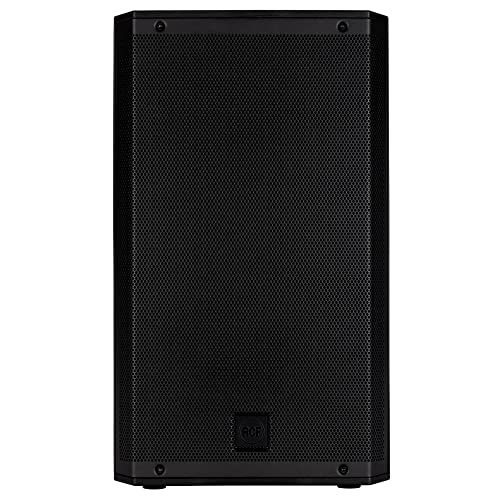
RCF ART 912-A 2,100W 12-inch Powered Speaker
$899.00 Specs and sizingAn Italian-built 12 with a 2,100 watt amplifier and RCF compression driver. Noticeably more forward and detailed than most of its price class, which flatters vocals.
Best for: Vocal-led worship where the lead voice must sit above the band
Check price on Amazon
JBL Professional PRX912 Next-Generation 12-Inch Powered Portable 2-Way Loudspeaker with DSP, 12-band parametric EQ, and Built-in Effects
$999.00 Specs and sizingA 2,000 watt class D cabinet with a full DSP suite and fly points, built to be installed and left alone rather than moved weekly.
Best for: A permanent flown install in a 300 to 600 seat room
Check price on Amazon
JBL Professional PRX915 Next-Generation 15-Inch Powered Portable 2-Way Loudspeaker with DSP, 12-band parametric EQ, and Built-in Effects
$1,099.00 Specs and sizingThe 15 inch PRX, for rooms where the band needs weight from the mains themselves.
Best for: Full-band contemporary worship in a large room
Check price on Amazon
RCF NX 912-A 2,100-watt 12-inch Powered Speaker
$1,449.00 Specs and sizingThe install and touring grade RCF 12, with a birch cabinet and a more capable DSP section than the ART.
Best for: A flagship room, or a church that buys once every fifteen years
Check price on AmazonOn this page
- How does the amplifier power calculation work?
- How many watts does a church need by seat count?
- How much does the service style change the answer?
- Why loudspeaker sensitivity matters more than the amplifier
- What distance does to the power requirement
- Which amplifier and loudspeaker combination matches the answer?
How does the amplifier power calculation work?
The formula is the one every loudspeaker manufacturer's application guide uses:
W = 10 ^ ( ( target SPL + headroom - sensitivity + 20 log10(distance / 1 m) ) / 10 )
- Target SPL is the average A-weighted level at the mix position, not the peak. Speech runs around 75 dBA and a modern full band runs near 100.
- Headroom is the gap between average and peak. Programme material peaks 10 to 12 dB above its average, and an amplifier that only just reaches the average clips on every transient. This term alone is a factor of 10 to 16 in watts, which is why two correct answers for the same room can look wildly different.
- Sensitivity is the level the loudspeaker makes from one watt at one metre. Every 3 dB halves the power needed.
- Distance is to the furthest seat. The inverse square law costs 6 dB every time it doubles.
Then there is a separate rule for matching an amplifier to a passive loudspeaker: choose an amplifier rated 1.6 to 2 times the speaker's continuous power. Under-powering blows more drivers than over-powering does, because a clipped small amplifier sends sustained near-DC into a tweeter.
How many watts does a church need by seat count?
Worked for a blended service at 88 dBA with 12 dB of headroom and a 96 dB sensitivity cabinet, using the standard assembly geometry of about 7 to 8 square feet per seat and a room half again as deep as it is wide.
A 250 seat church needs about 640 watts per loudspeaker and a 1,000 seat church about 2,400 watts, because the throw distance roughly doubles between them and doubling distance costs 6 dB.
| Church size | Throw to back row | Watts per box | Amplifier size | Total system |
|---|---|---|---|---|
| 75 seats | 26 ft | 158 W | 200 W | 316 W |
| 150 seats | 36 ft | 302 W | 400 W | 605 W |
| 250 seats | 45 ft | 473 W | 500 W | 945 W |
| 400 seats | 58 ft | 785 W | 800 W | 2,355 W |
| 600 seats | 71 ft | 1,176 W | 1,200 W | 3,529 W |
| 1,000 seats | 87 ft | 1,766 W | 2,000 W | 7,065 W |
Total system assumes two boxes up to 250 seats, three to 600 and four above that. Past roughly 700 seats a line array is the honest answer rather than more point-source boxes.
How much does the service style change the answer?
The same room, the same loudspeaker and the same 60 foot throw, at five different service styles.
Moving from a speech-only service to a modern full band service multiplies the amplifier requirement by more than thirty times in the same room, because both the target level and the required headroom go up together.
| Service style | Average level | Headroom | Watts per box |
|---|---|---|---|
| Speech and teaching only | 75 dBA | 10 dB | 27 W |
| Traditional, hymns and organ | 82 dBA | 12 dB | 211 W |
| Blended, piano and small band | 88 dBA | 12 dB | 840 W |
| Contemporary worship band | 95 dBA | 12 dB | 4,211 W |
| Modern, full band with in-ears | 100 dBA | 12 dB | 13,315 W |
Levels above 92 dBA carry a real hearing-exposure obligation. NIOSH allows about an hour at 94 dBA and about fifteen minutes at 100 dBA.
Why loudspeaker sensitivity matters more than the amplifier
Sensitivity is the specification nobody checks and it swamps almost everything else. This is the same room and the same target level with six different cabinets.
A 102 dB sensitivity loudspeaker needs roughly one sixteenth of the amplifier power of an 88 dB one to reach the same level in the same room.
| Sensitivity (1W/1m) | Watts needed | Relative to a 96 dB box |
|---|---|---|
| 88 dB | 5,301 W | 6.31x |
| 91 dB | 2,657 W | 3.16x |
| 94 dB | 1,332 W | 1.58x |
| 96 dB | 840 W | 1x |
| 99 dB | 421 W | 0.5x |
| 102 dB | 211 W | 0.25x |
Check which frequency the manufacturer quotes sensitivity at. A figure taken at 500 Hz flatters a cabinet compared with one averaged across its usable band.
What distance does to the power requirement
Every doubling of distance costs 6 dB and quadruples the power required: a seat at 120 feet needs sixteen times the amplifier of a seat at 30 feet.
| Distance to furthest seat | Loss from 1 metre | Watts needed |
|---|---|---|
| 20 ft | -15.7 dB | 93 W |
| 30 ft | -19.2 dB | 210 W |
| 40 ft | -21.7 dB | 373 W |
| 60 ft | -25.2 dB | 840 W |
| 80 ft | -27.7 dB | 1,494 W |
| 100 ft | -29.7 dB | 2,334 W |
| 120 ft | -31.3 dB | 3,360 W |
This is free-field behaviour. A real room reflects, so a reverberant sanctuary loses less level with distance than this table shows, and loses intelligibility instead, which is a worse trade.
Which amplifier and loudspeaker combination matches the answer?
The grid under the calculator filters to the loudspeakers whose rated power fits your result. As a guide: for a small room a QSC CP12 12-Inch Compact Powered Loudspeaker at $649.99 has far more headroom than the arithmetic calls for, a mid-size sanctuary usually lands on the QSC K12.2 Active 12" Powered 2000 Watt Loudspeaker or the JBL Professional EON712 Powered PA Speaker, 12 inch, 1300 Watt, and a large room on the JBL Professional PRX912 Next-Generation 12-Inch Powered Portable 2-Way Loudspeaker with DSP, 12-band parametric EQ, and Built-in Effects or the RCF NX 912-A 2,100-watt 12-inch Powered Speaker. If you are building a passive system, the Crown XLS1502 2-Channel Class D DriveCore Professional Power Amplifier with DSP, Band Pass Filters & Peak Limiters. XLR/RCA Inputs, 525W at 4 Ohm, PureBand Crossover System. Black is the amplifier most often specified for a pair of church mains, with the Crown XLS2502 2-Channel Class D DriveCore Professional Audio Power Amplifier with DSP, Band Pass Filters & Peakx Limiters. XLR/RCA Inputs, 775W at 4 Ohm, PureBand Crossover System. Black for larger cabinets or a passive subwoofer.
Once you have the power figure, check the coverage separately: a loudspeaker with enough power and the wrong pattern still leaves seats uncovered. Use the coverage angle calculator and the sanctuary coverage calculator.
Frequently asked questions
How many watts do I need for a church sound system?
For a typical 250 seat church with a blended service, about 640 watts per loudspeaker, or roughly 1,900 watts of total amplification across three boxes. But watts alone is the wrong question: the same room needs a sixteenth of that with a highly sensitive horn-loaded cabinet and eight times more with a modern full band. Enter your own throw distance, speaker sensitivity and service style rather than using a watts-per-seat rule.
What is amplifier headroom and why does it add so much power?
Headroom is the difference between the average level and the peaks. Music and speech peak roughly 10 to 12 dB above their average level, and every 3 dB doubles the power required, so 12 dB of headroom means sixteen times the power of the average alone. An amplifier sized only for the average clips on every transient, which sounds harsh and is the fastest way to destroy a compression driver.
Should the amplifier be bigger than the speaker rating?
Yes, and this surprises people. The accepted rule is an amplifier rated 1.6 to 2 times the loudspeaker continuous power. A large amplifier used sensibly delivers clean peaks and stays well within the speaker limits. A small amplifier driven into clipping sends a sustained, nearly square waveform into the speaker, and it is that, not excess power, that kills most tweeters.
Does a bigger room always need more power?
It needs more power because the furthest seat is further away, not because there are more people. Distance is the only geometric factor in the calculation, and it follows the inverse square law: doubling it costs 6 dB and quadruples the watts. A wide shallow room with 400 seats can need less power than a narrow deep room with 250.
Do powered speakers change this calculation?
No, but they answer it for you. A powered loudspeaker has its amplifier matched to its drivers by the manufacturer, so the question becomes whether that cabinet as a whole can produce the level you need at your distance, which is what the maximum SPL specification tells you. The arithmetic here is most directly useful when you are choosing a separate amplifier for passive speakers.
What target level should we design for?
Speech-only services run comfortably at 70 to 78 dBA, a traditional service with hymns and organ at 78 to 85, a blended service at 85 to 90 and contemporary worship at 92 to 98. Design for the loudest programme the room will actually host, then run quieter. Note that anything sustained above 85 dBA carries a real hearing-exposure obligation and that offering ear protection is reasonable above about 95.
Researched, not professional advice. This page is compiled from published manufacturer specifications, operator manuals, FCC rules, published standards and owner-review consensus, not hands-on testing. Sound system design, rigging loudspeakers overhead, and any electrical work are jobs for a qualified professional: have flown loudspeakers and their attachment points signed off by a structural engineer or a certified rigger, and have all wiring done by a licensed electrician to your local code. Wireless microphone rules change, so confirm the current FCC position before buying. As an Amazon Associate we earn from qualifying purchases.