Livestream systems
Multi-Camera Church Livestream System
Quick answer
A three camera church livestream system costs about $6,485. It runs three pan tilt zoom cameras on one network, a switcher that records every input separately so a bad cut can be fixed afterwards, and a dedicated broadcast audio mix rather than a copy of the house mix.
The jump from one camera to three is not really a jump in picture quality, it is a jump in operational complexity: somebody now has to make decisions live, every week, in front of everyone. The equipment choices here are aimed squarely at that. Isolated recording means a bad cut is recoverable. Auto-tracking means a camera can hold a shot without an operator. And a separate broadcast mix means the audio no longer depends on what the room happened to need.
The complete build: $6,485
Cameras
Three angles that earn their place: a wide that always works, a close shot of the speaker, and a side or musician angle. A fourth camera almost never adds anything a volunteer can use.
| Item | Why this one | Qty | Price | Buy |
|---|---|---|---|---|
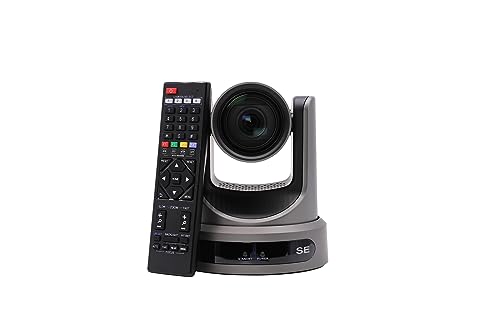 PTZOptics Move SE 20x 1080p Full HD PTZ Auto-Tracking Pan Tilt Zoom Camera PTZOptics Move SE 20x 1080p Full HD PTZ Auto-Tracking Pan Tilt Zoom Camera | Two 20x pan tilt zoom cameras with power over Ethernet, for the wide shot and a side angle, both controlled from the same position. | 2 | $2,563.10 | Price |
 PTZOptics Move 4K 12X Optical Zoom Camera - Grey PTZOptics Move 4K 12X Optical Zoom Camera - Grey | A 4K camera with a wider 12x lens for the close shot from a short distance, where shooting 4K and delivering 1080p lets you crop in without losing resolution. | 1 | $1,999.00 | Price |
 Cable Matters 10Gbps Snagless Shielded Cat 6A Ethernet Cable, 100ft Cable Matters 10Gbps Snagless Shielded Cat 6A Ethernet Cable, 100ft | Shielded runs carrying power, control and video to each camera position. | 4 | $119.96 | Price |
| Cameras subtotal | $4,682.06 | |||
Switching and capture
| Item | Why this one | Qty | Price | Buy |
|---|---|---|---|---|
 Blackmagic Design ATEM Mini Pro ISO HDMI Switcher Blackmagic Design ATEM Mini Pro ISO HDMI Switcher | Four inputs with isolated recording of every one, plus a hardware encoder that streams without a computer. | 1 | $585.00 | Price |
 Elgato Cam Link 4K Capture Card for DSLR, Camcorder, Action Cam, USB-A Connector, USB 3.0 Hardware Interface, Black, Windows 10/11 and macOS Elgato Cam Link 4K Capture Card for DSLR, Camcorder, Action Cam, USB-A Connector, USB 3.0 Hardware Interface, Black, Windows 10/11 and macOS | A reliable capture path for a fourth source such as a presentation computer or a guest camera. | 1 | $89.99 | Price |
| Switching and capture subtotal | $674.99 | |||
Broadcast audio
The most common quality gap in church streaming is using the house mix. A room supplies drums and acoustic guitar for free; headphones do not.
| Item | Why this one | Qty | Price | Buy |
|---|---|---|---|---|
 Focusrite Scarlett 4i4 4th Gen USB-C Audio Interface Focusrite Scarlett 4i4 4th Gen USB-C Audio Interface | Four in and four out, so the stream takes its own dedicated mix from the console and can send a return feed for talkback. | 1 | $299.99 | Price |
 Audio-Technica ATH-M50X Professional Studio Monitor Headphones, Black, Professional Grade, Critically Acclaimed, with Detachable Cable Audio-Technica ATH-M50X Professional Studio Monitor Headphones, Black, Professional Grade, Critically Acclaimed, with Detachable Cable | A more revealing closed-back headphone than a general monitoring pair, which is what the person checking the stream mix needs. | 1 | $158.00 | Price |
 Sennheiser HD 280 Pro Headphone Sennheiser HD 280 Pro Headphone | A second pair of isolating headphones for the video operator. | 1 | $85.49 | Price |
| Broadcast audio subtotal | $543.48 | |||
Rack, power and network
| Item | Why this one | Qty | Price | Buy |
|---|---|---|---|---|
 Gator Cases Pro Series 12U Rack Case, Standard 19" Depth (G-PRO-12U-19) Gator Cases Pro Series 12U Rack Case, Standard 19" Depth (G-PRO-12U-19) | A dedicated video rack so the stream gear is never unplugged to borrow an outlet. | 1 | $329.99 | Price |
 Furman PL-8C Classic 15A Power Conditioner, 9 Outlets & LED Rack Lights Furman PL-8C Classic 15A Power Conditioner, 9 Outlets & LED Rack Lights | Filtered power with rack lights at the video position. | 1 | $254.97 | Price |
| Rack, power and network subtotal | $584.96 | |||
Equipment only, and it assumes a network switch with power over Ethernet and enough budget for three cameras already exists or is provided by the building. Cable pulls to three camera positions in an occupied building are frequently the largest hidden cost in this project.
- Cameras
- 3, all network powered
- Resolution
- 1080p at 30 fps
- Upload needed
- About 10 Mbps measured, wired
- Console sends used
- 2 for a dedicated stream mix
- Volunteers needed
- 2, one video and one audio
- Network ports needed
- 5 with power over Ethernet
Prices were accurate when this list was compiled and change often, so confirm each one before the committee votes. Quantities are multiplied into the total. This total covers equipment only: it does not include installation labor, rigging, conduit, electrical work or permits, which on an installed system commonly add 30 to 60 percent.
Why the broadcast mix cannot be the house mix
In a room, a drum kit and an acoustic guitar are already loud. The console only needs to add a little of each, because the room supplies the rest for free. A microphone in the room hears all of it.
A stream hears only what is in the mix. So a house mix sent to the stream arrives with almost no drums, almost no acoustic guitar and a vocal that is far too loud relative to a band that has largely vanished. That single fact explains most of the difference between a church stream that sounds professional and one that does not, and it is why this build spends on a separate mix rather than on a fourth camera.
The practical minimum is one extra stereo bus with its own fader for every channel. The better answer, if the console has the outputs, is recording every channel so the mix can be built afterwards. See how to mix for livestream.
Camera positions that actually work
Three cameras is the most a single volunteer can cut well: a locked-off wide as the safety shot, a close shot of the speaker, and one side angle for the band.
| Camera | Position | Shot | Why |
|---|---|---|---|
| Wide | Back wall or balcony rail, centred | The whole platform, locked off | The shot you cut to when anything goes wrong. Never move it. |
| Close | Back wall, slightly off centre | Head and shoulders of the speaker | Off centre so the speaker is not looking down the lens, which reads as confrontational |
| Side | Side wall at platform height | Band, musicians, a cutaway | Gives the cut somewhere to go during music without moving the wide |
| Fourth, if added | Anywhere | Usually unused | Skip it. Three is the practical ceiling for one operator. |
Mount cameras above standing head height, and never in a walkway. A camera at eye level in an aisle will be knocked, and the shot it gives is worse anyway.
What you can skip
Skip the fourth camera. Three angles is the most a single volunteer can cut well. A fourth becomes a shot that is never used, or worse, used badly.
Skip auto-tracking on the wide camera. The wide shot should be locked off: it is the shot you cut to when anything goes wrong, and a moving safety shot is not a safety shot.
Skip a hardware control panel, at first. The switcher software controls the cameras adequately, and one more surface is one more thing to learn and one more thing that can be left unplugged.
What to upgrade first
Lighting on the speaker. Three cameras pointed at a badly lit face produce three badly lit pictures. Most sanctuaries are lit for a congregation to read by, which is a completely different requirement, and fixing the key light does more for the stream than any camera on this list.
Then multitrack recording, so the stream mix can be built properly. An eighteen input interface records every channel, which means the broadcast mix stops being whatever the room needed and starts being mixed for headphones.
Frequently asked questions
How much does a three camera church livestream system cost?
About $6,485 for the equipment, covering three network cameras, a switcher with isolated recording, a dedicated broadcast audio path and a rack. Cable pulls to three camera positions in an occupied building are the usual hidden cost and are not included.
Do we need three cameras to livestream church?
No. One well-placed camera with excellent audio is a perfectly good stream, and it is the right place to start. Three cameras are worth it once the single shot has become visually monotonous and you have a volunteer who genuinely wants to learn to cut live, which is a skill rather than a setting.
What is ISO recording and why does it matter?
Isolated recording captures each camera input separately alongside the programme output, plus a project file for an editing application. It means a cut made at the wrong moment is fixable afterwards rather than permanent, which is what allows a volunteer to learn to cut live without every mistake living in the archive.
Are PTZ cameras better than camera operators?
For a church, usually yes. Pan tilt zoom cameras mean one person runs three angles, they sit above head height out of the congregation’s sightline, they take power and control down one network cable, and they are always in position. A human operator gets better shots, but a church rarely has three spare volunteers every week for years.
Why does our stream look worse than the room?
Almost always lighting rather than the camera. A sanctuary is lit so a congregation can read, which usually means diffuse overhead light that puts shadows in eye sockets and under chins. A camera has far less dynamic range than an eye, so it exaggerates all of it. Adding a key light on the speaking position improves the picture more than any camera upgrade at this level.
Researched, not professional advice. This page is compiled from published manufacturer specifications, operator manuals, FCC rules, published standards and owner-review consensus, not hands-on testing. Sound system design, rigging loudspeakers overhead, and any electrical work are jobs for a qualified professional: have flown loudspeakers and their attachment points signed off by a structural engineer or a certified rigger, and have all wiring done by a licensed electrician to your local code. Wireless microphone rules change, so confirm the current FCC position before buying. As an Amazon Associate we earn from qualifying purchases.