Livestream video
PTZ Camera vs Camcorder
Quick answer
Volunteer count decides this. A PTZ camera needs no operator once its presets are stored, which is why three PTZ cameras and one operator is the standard church configuration. A camcorder produces a better image in low light and needs a person standing behind it.
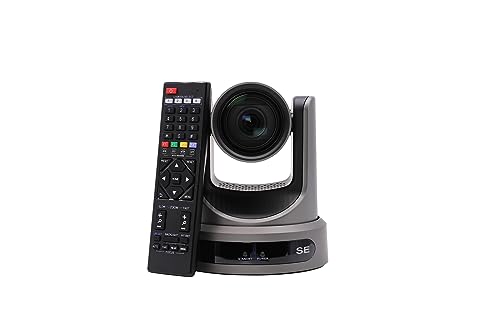
PTZOptics Move SE 20x 1080p Full HD PTZ Auto-Tracking Pan Tilt Zoom Camera
$1,281.55 Specs and sizingA 20x pan tilt zoom camera with power over Ethernet and auto-tracking, so one cable does video and power and one volunteer can run three cameras.
Best for: The standard church livestream camera, on a balcony rail or a side wall
Check price on Amazon
Canon XA60 Professional UHD 4K Camcorder Lens Kit
$1,949.00A traditional camcorder with a 20x zoom, XLR audio inputs and UVC streaming over USB, so it appears to a computer as a webcam with no capture card at all.
Best for: A manned camera operator position, and outreach video off site
Check price on AmazonAsk how many people will be on the video rota, not which camera has the better sensor. A PTZ camera mounts on a wall or a balcony rail, stores its shots as presets, and is recalled by one operator sitting at the switcher. A camcorder produces a noticeably better image, especially on a dimly lit platform, and requires a human being behind it for the whole service.
For most churches that settles it. Three PTZ cameras and one operator is the standard configuration precisely because finding one video volunteer each week is achievable and finding three is not. Where camcorders still win is the single hero shot and any church that already has camera operators who enjoy the job. Position them using the camera positioning guide.
Side by side
| Model | Price | Maximum resolution | Optical zoom | Streaming output | SDI output | NDI | Power over Ethernet |
|---|---|---|---|---|---|---|---|
| PTZOptics Move SE 20x 1080p Full HD PTZ Auto-Tracking Pan Tilt Zoom Camera | $1,281.55 | 1080p60 | 20x | SDI, HDMI, USB and IP | Yes | No | Yes |
| Canon XA60 Professional UHD 4K Camcorder Lens Kit | $1,949.00 | 2160p30 | 20x | UVC over USB and HDMI | - | - | - |
What each one asks of your church
The specifications are closer than the price suggests. The operational differences are not close at all.
A PTZ camera needs no volunteer once its presets are stored, which is why three PTZ cameras and one operator is the standard church configuration rather than three camcorders and three people.
| Requirement | PTZ camera | Camcorder | Notes |
|---|---|---|---|
| Volunteers per camera | None after presets are set | One | The decisive line for most churches |
| Cabling | One Cat6 for video, control and power | Video cable plus mains power | Power over Ethernet removes the outlet |
| Image in low light | Weaker, smaller sensor | Better | A dark platform shows this up |
| Optical zoom | 20x | 20x | Level on paper |
| Mounting | Wall or balcony rail, out of the sightline | Tripod, usually in a sightline | A tripod in the aisle is a real objection |
| Moves on air | Visible unless cut preset to preset | Smooth, a human is driving | Move off air, then cut |
| Audio inputs | None needed, audio comes from the console | XLR inputs on the body | Both should take audio from the mixer |
| Price | $1,281.55 | $1,949.00 | Per camera position |
Neither camera should be the source of your livestream audio. Take audio from the mixing console through an interface in both cases, which is the single biggest improvement available to most church streams.
Choose PTZ cameras for a volunteer-run multi-camera stream
Power over Ethernet is the practical reason these took over church video. One Cat6 cable to a balcony rail carries the image, the pan tilt zoom control and the power, so there is no outlet to install at height and no separate control cable. That single fact removes most of the installation cost of a camera position.
Presets are the second reason. A wide shot, a shot of the pulpit and a shot of the worship team are stored once and recalled instantly, so an operator who has never touched a camera can produce a competent three camera cut after ten minutes of instruction. Auto-tracking will follow a speaker who paces, which handles the position a preset cannot.
The honest weaknesses: a small sensor struggles on a dimly lit platform where a large sensor camera would cope, and a motorised move looks mechanical on air, so move the camera while it is off air and cut to it once it has arrived. If one shot needs to look genuinely cinematic, add a Sony FX30 at $2,098.00 as a locked-off hero camera alongside the PTZ cameras rather than replacing them.
Choose a camcorder when you have people who want to operate
A camcorder is the right answer when the church has camera operators who enjoy the job and will keep turning up. A human following a preacher produces better framing than any preset or tracking algorithm, and the larger sensor and lens handle a dim platform far better. The XA60 at $1,949.00 also streams over USB as a standard webcam, so it needs no capture card at all, which simplifies an OBS setup considerably.
It is also the more flexible purchase. A camcorder goes to the baptism at the lake, the outreach event in the car park and the wedding on Saturday. A wall-mounted PTZ camera does none of those things. For a church that produces video beyond the Sunday service, one good camcorder earns its keep across the week.
The costs are a tripod position in a sightline that somebody will object to, a person committed for the whole service, and a cable run that carries no power. If the operator rota fails one Sunday, that camera simply does not exist, where a PTZ camera on a preset still delivers a usable shot. Plan the positions in the multi-camera setup.
Sources
- PTZOptics published Move SE series specifications
- Canon published XA60 specifications
Frequently asked questions
How many PTZ cameras does a church actually need?
Three covers almost every sanctuary: a wide shot that always works, a tighter shot of the speaking position, and a side or balcony angle for the worship team. Two is enough for a smaller room. Start with the wide shot, because a stream with one good wide camera beats a stream with three badly placed ones.
Does auto-tracking work well enough to trust on a Sunday?
For a single speaker moving across a defined area, generally yes, and it has improved a great deal. It struggles when several people are on the platform, when somebody crosses in front of the subject, or against a busy background. Keep a wide shot available to cut to, and treat tracking as a convenience rather than as an unattended operator.
Can we mix PTZ cameras and a camcorder in one system?
Yes, and it is a common and sensible arrangement. Use PTZ cameras for the shots that must exist every week regardless of who turns up, and a manned camcorder or a large sensor camera for the one shot that should look special. Match the frame rate and the colour settings as closely as the cameras allow so cuts do not jar.
What cable do we need for a PTZ camera?
Shielded Cat6 or Cat6A to a switch that supplies power over Ethernet, and keep the run out of any conduit carrying mains wiring. Check the power budget of the switch against the number of cameras, because power over Ethernet ports have a total budget that three cameras plus other devices can exceed.
Why does our camera image look poor even though it is 1080p?
Almost always lighting rather than the camera. A platform lit for the congregation rather than for video gives a camera very little to work with, and every camera responds by raising gain, which adds noise. Fixing the platform lighting improves the stream more than any camera upgrade at the same price would.
Researched, not professional advice. This page is compiled from published manufacturer specifications, operator manuals, FCC rules, published standards and owner-review consensus, not hands-on testing. Sound system design, rigging loudspeakers overhead, and any electrical work are jobs for a qualified professional: have flown loudspeakers and their attachment points signed off by a structural engineer or a certified rigger, and have all wiring done by a licensed electrician to your local code. Wireless microphone rules change, so confirm the current FCC position before buying. As an Amazon Associate we earn from qualifying purchases.