Loudspeakers
Best Passive Speakers for Churches
Quick answer
A passive church system pairs each loudspeaker with an amplifier rated at roughly twice its continuous power. A 250 watt cabinet wants about 500 watts per channel, which the Crown XLS1502 at $579.99 delivers into 4 ohms with processing built in.
A passive loudspeaker has no amplifier inside it. Power arrives from a rack amplifier over speaker cable, and processing comes from a separate unit or from the amplifier itself. That architecture is chosen for three reasons: every amplifier lives in one lockable rack, no mains power is needed at the speaker positions, and a failed amplifier is swapped in minutes rather than sent away inside a speaker cabinet.
The cost is that the church must now match amplifier to loudspeaker correctly. That arithmetic is the whole of this page. Work your requirement in the amplifier power calculator, and settle the architecture question first in powered against passive.
On this page
Why under-powering destroys more drivers than over-powering
This is the single most useful thing on this page, and it is counter-intuitive enough that it costs sales of small amplifiers. A large amplifier does not damage a loudspeaker by being large. It damages a loudspeaker only if someone drives it far past the cabinet rating for a sustained period, and most amplifiers of any size can do that.
What actually kills drivers in churches is a small amplifier driven into clipping. When an amplifier runs out of voltage it squares off the waveform, which produces a large amount of high frequency energy that goes straight to the compression driver. Tweeters fail this way constantly in church systems, and the usual diagnosis is wrongly recorded as the amplifier being too big.
So the rule is to choose an amplifier rated at roughly twice the loudspeaker continuous power at the impedance being used, then set the limiter and leave headroom. The amplifier spends its life loafing, the waveform stays clean, and the drivers survive. Size it properly with the amplifier power calculator rather than by guesswork.
Matching amplifier to passive loudspeaker
Continuous power ratings from the catalog, with the amplifier that gives roughly the right headroom.
A 250 watt continuous cabinet wants about 500 watts per channel of amplifier, which is why a 525 watt at 4 ohms amplifier is the standard pairing for a pair of church mains.
| Passive loudspeaker | Continuous rating | Impedance | Amplifier target | Suggested amplifier |
|---|---|---|---|---|
| ZLX-12 G2 | 250 watts | 8 ohms | about 500 watts per channel | XLS 1502 |
| PRX412M | 400 watts | 8 ohms | about 800 watts per channel | XLS 2502 |
| JRX218S subwoofer | 350 watts | 8 ohms | about 700 watts per channel | XLS 2002 |
| Control 25-1 | 100 watts | 8 ohms or 70V | about 200 watts per channel | XLS 1002 |
| Control 416C/T | 50 watts | 8 ohms or 70V | 70 volt line amplifier | CDi 1000 |
Amplifier figures are published power at the stated impedance. Doubling the continuous rating is a headroom convention, not a licence to turn everything up: set the amplifier limiter during commissioning and lock it.
Small church: one amplifier, two speakers
The simplest passive system is two loudspeakers and one two-channel amplifier with processing built in. At this size no separate loudspeaker processor is needed, because the crossover, limiting and basic equalisation are inside the amplifier.

Electro-Voice ZLX-12-G2 1,000-watt 12-inch Passive Speaker
$449.00 Specs and sizingThe passive version of a well regarded powered box, with the same 90 by 60 waveguide, for a system built around a rack amplifier rather than amplifiers in each cabinet.
Best for: Installed small church systems where every amplifier lives in one rack
Check price on Amazon
Crown XLS1002 2-Channel Class D DriveCore Professional Power Amplifier with DSP, Band Pass Filters & Peakx Limiters. XLR/RCA Inputs, 350W at 4 Ohm, PureBand Crossover System. Black
$439.88 Specs and sizingTwo channels at 350 watts into 4 ohms with crossovers, limiting and delay built in, in one rack unit weighing under nine pounds.
Best for: A pair of passive mains in a room up to about 150 seats
Check price on AmazonWho should not buy this tier: Portable churches that set up weekly, where a powered box removes the rack, the cabling and the matching problem entirely.
Mid-size: mains, fills and a processor
A mid-size passive system usually has more than two loudspeakers: mains, a pair of under-balcony or foyer fills, perhaps a monitor wedge. That is the point at which a dedicated loudspeaker processor earns its place, because each output needs its own crossover, delay and limiting. The options are set out in the loudspeaker processor roundup.

JBL Professional PRX412M Portable 2-way Passive Utility Stage Monitor and Loudspeaker System, 12-Inch
$699.00 Specs and sizingA 400 watt passive 12 that works as a main, a side fill or a floor wedge, so one spare cabinet covers several roles in the building.
Best for: Platforms where running mains power to each speaker position is a problem
Check price on Amazon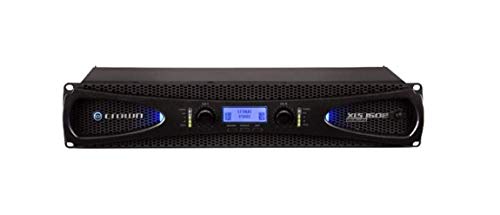
Crown XLS1502 2-Channel Class D DriveCore Professional Power Amplifier with DSP, Band Pass Filters & Peak Limiters. XLR/RCA Inputs, 525W at 4 Ohm, PureBand Crossover System. Black
$579.99 Specs and sizingTwo channels at 525 watts into 4 ohms with onboard crossover and limiting, in one rack unit. The amplifier most often specified for a pair of passive church mains.
Best for: A 150 to 400 seat room with passive mains and no separate processor
Check price on Amazon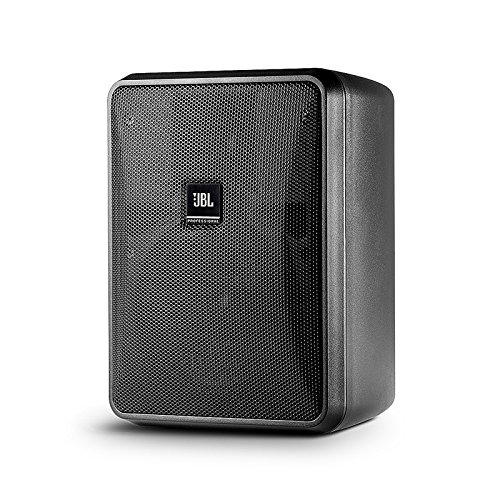
JBL Professional Control 25-1 Compact Indoor/Outdoor Background/Foreground Speaker, Black, Sold as Pair
$457.98 Specs and sizingA surface-mount cabinet that runs at 8 ohms or on a 70 volt line, indoor or outdoor rated, with a bracket that aims it properly. Sold as a pair.
Best for: Under-balcony fills, foyers, cry rooms and side aisles
Check price on AmazonWho should not buy this tier: Churches with nobody competent to set crossover points and limiters, unless an integrator commissions the system.
Large installed system: subwoofers and delay zones
A large passive system has several zones, each needing its own processing: mains, subwoofers, delay speakers under a balcony, and often a separate feed to an overflow room. Time alignment between those zones is what makes the system sound like one system, and that is a processor function rather than an amplifier one.

JBL Professional JRX218S Portable PA, Line Array, Stage Subwoofer, 1400W Power Handling, Passive, Non-Powered, 18-Inch
$680.00 Specs and sizingA passive 18 inch subwoofer for a system that already has amplifier channels spare, which is the cheapest honest route to low end when the rack has room.
Best for: Rack-amplified systems with an unused amplifier channel
Check price on Amazon
Crown XLS2502 2-Channel Class D DriveCore Professional Audio Power Amplifier with DSP, Band Pass Filters & Peakx Limiters. XLR/RCA Inputs, 775W at 4 Ohm, PureBand Crossover System. Black
$843.98 Specs and sizingTwo channels at 775 watts into 4 ohms, which is the right size for a passive subwoofer pair or for high-sensitivity mains in a large room.
Best for: Passive subwoofers, or mains in a 500 seat and up sanctuary
Check price on Amazon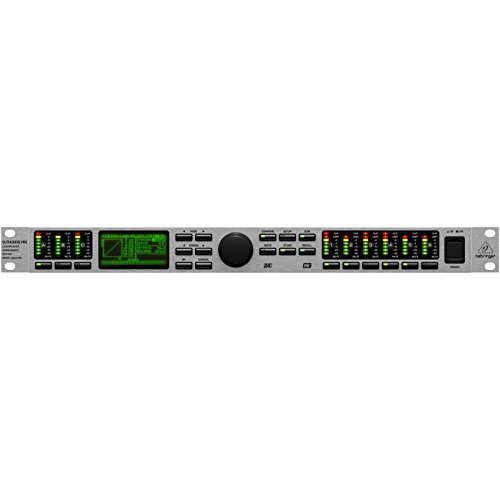
Behringer Ultradrive Pro Dcx2496 Ultra High-Precision Digital 24-Bit/96 Khz Loudspeaker Management System
$339.00 Specs and sizingA three in, six out digital loudspeaker manager with crossovers, delay and limiting on every output, which is what a delay-speaker system needs to be time-aligned.
Best for: Systems with under-balcony or mid-room delay speakers
Check price on AmazonWho should not buy this tier: Do not buy this tier for a two-speaker system. A multi-zone processor and a large amplifier add configuration that a simple system does not need, and a mis-set crossover in a processor nobody understands will damage drivers faster than any amount of power. Two speakers and one amplifier with onboard processing is the correct answer at that size.
Planning the amplifier rack
A passive system means a rack, and a rack needs planning. Each power amplifier wants a vented space above it, a power conditioner protects everything in it, and the total current draw needs checking against the circuit. Two large amplifiers, a processor and a mixer can exceed a single domestic circuit under load.
Leave spare rack units. The two things most often added later are a second amplifier for a new zone and a wireless receiver, and both need space and power. Full guidance is in church AV rack planning, and the amplifier choices themselves are covered in the power amplifier roundup.
One final honest note. If the church is portable, or has no technically confident volunteer, passive is probably the wrong architecture despite its advantages. Powered speakers remove the matching, the crossover settings and the rack entirely, and a system nobody can misconfigure is worth a great deal in a volunteer-run building.
How we chose
We did not test these products in person and we never claim to. Picks are researched from manufacturer specification sheets and operator manuals, FCC rules where spectrum is involved, published standards, warranty terms, and the recurring themes in verified owner reviews. Every pick is matched to a real room size, seat count or input list rather than to a price bracket, and it is placed in the tier where its capability actually belongs. Where a product is wrong for most churches we say so on the page.
Sources
- Manufacturer published power ratings and impedance specifications
- Published amplifier power figures at stated impedances
Frequently asked questions
Can an amplifier be too powerful for a church speaker?
Only if someone drives it far beyond the cabinet rating for a sustained period. The far more common failure is a small amplifier pushed into clipping, which sends a burst of high frequency energy into the compression driver and destroys tweeters. Choosing an amplifier rated at roughly twice the speaker continuous power, then setting its limiter, is safer than choosing a smaller one.
How do we know what impedance our speakers present?
A single 8 ohm cabinet on a channel presents 8 ohms. Two 8 ohm cabinets wired in parallel on one channel present 4 ohms, which makes the amplifier work harder and deliver more power. Never take a channel below the minimum impedance printed on the amplifier, since that causes protection shutdowns mid-service or, in older designs, permanent damage.
Do passive speakers sound worse than powered ones?
No. The difference is where the amplifier and processing live, not in the sound quality available. Powered boxes have the advantage of factory-matched amplification and limiting, which removes several ways to get it wrong. Passive systems can equal or exceed them when the amplifier and processor are properly specified and commissioned, and they are easier to service.
Should the crossover be in the amplifier or a separate box?
For a two-speaker system, the amplifier crossover is enough and one less thing to configure. Once the system has mains, subwoofers and delay speakers, a dedicated processor is better because each output needs its own crossover point, delay time and limiter. Time alignment between zones is the specific job a separate processor does that an amplifier crossover usually cannot.
Can we mix powered and passive speakers in one church?
Yes, and many churches do. A common arrangement is powered main loudspeakers with passive ceiling speakers on a 70 volt line for the foyer and cry room, since those small speakers are far cheaper without individual amplifiers. What matters is that each zone is level matched and, where it covers seating within earshot of the mains, correctly delayed.
What gauge speaker cable does a church need?
It depends on run length and impedance. A short run to a nearby cabinet is fine on 16 gauge, while a long run to an under-balcony fill at 4 ohms may need 12 gauge to keep loss under four tenths of a decibel. Calculate each run rather than using one gauge everywhere, since the long runs are where thin cable costs real output.
Researched, not professional advice. This page is compiled from published manufacturer specifications, operator manuals, FCC rules, published standards and owner-review consensus, not hands-on testing. Sound system design, rigging loudspeakers overhead, and any electrical work are jobs for a qualified professional: have flown loudspeakers and their attachment points signed off by a structural engineer or a certified rigger, and have all wiring done by a licensed electrician to your local code. Wireless microphone rules change, so confirm the current FCC position before buying. As an Amazon Associate we earn from qualifying purchases.