Loudspeakers
Best Powered Speakers for Churches
Quick answer
The QSC K12.2 at $899.99 is the best powered speaker for most churches, with 2,000 watts and a 75 degree conical pattern for throws up to about 70 feet. Wide, shallow rooms should choose a 90 or 100 degree box instead of a louder one.
A powered loudspeaker carries its own amplifier and processing, so the system is a speaker, a signal cable and a power outlet. That removes an amplifier rack, removes the need to match amplifier power to speaker rating, and removes the most common way churches destroy drivers, which is a small amplifier driven into clipping.
What it adds is a mains outlet at every speaker position, which in an old building is not trivial. Choose the pattern first using the speaker coverage calculator, confirm the power requirement in the amplifier power calculator, and settle the architecture question in powered against passive before ordering anything.
On this page
Choose the pattern, not the wattage
Wattage tells you how loud a box can go. Coverage pattern tells you where that sound lands, and in a church the second matters more. A 75 degree speaker in a wide fan-shaped room leaves the outer seats uncovered no matter how many watts it has. A 105 degree speaker in a long narrow room sprays the side walls, raising reverberation and making speech harder to follow.
The practical method is to measure the width of the seating at the back row and the distance from the speaker to that row, then pick the pattern whose coverage equals that width at that distance. Two boxes aimed to cross at roughly two thirds of the room depth is the usual arrangement.
Vertical pattern matters too, and is more often ignored. A box with a 60 degree vertical pattern mounted at head height throws most of its energy at the back wall. Getting it above the congregation and tilting it down is worth more than an upgrade to a larger model.
Coverage pattern by room shape
Published coverage figures for the powered speakers in this catalog, with the room each one suits.
A 75 degree conical box covers about 62 feet of width at a 70 foot throw, which is why it is the standard choice for a long, narrow sanctuary.
| Loudspeaker | Woofer | Published pattern | Room shape it suits |
|---|---|---|---|
| K12.2 | 12 inch | 75 by 75 conical | Long and narrow, throws to 70 feet and beyond |
| CP12 | 12 inch | 75 by 75 conical | Narrow small rooms, portable use |
| K10.2 | 10 inch | 90 by 90 conical | Square or moderately wide rooms |
| K8.2 | 8 inch | 105 by 105 conical | Very wide shallow rooms, front fills, side fills |
| EON712 | 12 inch | 100 by 60 degrees | Wide rooms of moderate depth |
| ZLX-12P G2 | 12 inch | 90 by 60 degrees | General purpose, most rectangular sanctuaries |
| ELX200-12P | 12 inch | 90 by 60 degrees | Permanent installs on wall brackets |
A conical pattern covers the same angle horizontally and vertically, which keeps tone consistent for someone sitting off to one side. A 100 by 60 pattern is wider across the room and tighter vertically, which suits a wide room with a low ceiling.
Small church: a pair on stands
For a small sanctuary, a pair of powered 12 inch boxes on stands is a complete main system. All three of these include processing and limiting, so a volunteer cannot easily damage them, and none need an amplifier rack.

Yamaha DBR Series DBR 12" Powered Speaker Cabinet
$390.99 Specs and sizingProcessing borrowed from a much dearer Yamaha series in a 34 pound cabinet with a published 131 dB maximum. Neutral, reliable and forgiving of a rough mix.
Best for: A 75 to 200 seat room run by volunteers
Check price on Amazon
Electro-Voice ZLX-12P-G2 12in. 2-Way Powered Loudspeaker with Bluetooth
$549.00 Specs and sizingA genuine 90 by 60 degree waveguide with a 1,000 watt amplifier and app control, which gives real pattern control rather than a nominal specification.
Best for: Rectangular sanctuaries where sound needs to stay off the side walls
Check price on Amazon
Mackie Thump215 15" 1400W Powered Loudspeaker with Heavy-Duty Drivers
$414.95 Specs and sizingA 15 inch powered box that is loud and honest about being a budget cabinet. The cheapest speaker here that still belongs in front of a congregation.
Best for: A church plant that has to be heard this Sunday on minimal budget
Check price on AmazonWho should not buy this tier: Rooms over about 250 seats, and anywhere the mains must also serve as stage monitors.
Mid-size: 200 to 500 seats
In this range the choice is genuinely about pattern and low end rather than about brand. A 15 inch box delays the need for a subwoofer, a 10 inch box with a wide pattern fixes a fan-shaped room, and an install-grade 12 is the right answer where the speakers go on the wall and stay there. The two most commonly compared options are covered in K12.2 against EON712.

JBL Professional EON712 Powered PA Speaker, 12 inch, 1300 Watt
$549.00 Specs and sizingA waveguide-loaded 12 with a 100 by 60 pattern, wider horizontally than most rivals, so it covers the front pews better and the back wall slightly less.
Best for: Wide rooms of moderate depth where the front rows are currently being missed
Check price on Amazon
QSC K10.2 Active 10" Powered 2000 Watt Loudspeaker
$799.99 Specs and sizingA 90 degree conical pattern with the full 2,000 watt amplifier, so someone sitting well off axis hears the same tone as someone on the centre line.
Best for: Fan-shaped rooms and balcony fills
Check price on Amazon
Electro-Voice ZLX-15P-G2 15in. 2-Way Powered Loudspeaker with Bluetooth
$649.00 Specs and sizingThe 15 inch version of the ZLX, trading a little pattern control for noticeably more low end at the price of many 12 inch boxes.
Best for: Small to mid-size rooms with a band and no subwoofer budget
Check price on AmazonWho should not buy this tier: Rooms over 600 seats, or systems where every amplifier must live in one lockable rack.
Large room: high output and install grade
The expert tier is about headroom and consistency at level. These boxes hold their tone as they get loud, which is what keeps a spoken word intelligible over a band in a large room. They are also heavier and are usually flown, which is engineering work rather than volunteer work.

QSC K12.2 Active 12" Powered 2000 Watt Loudspeaker
$899.99 Specs and sizingThe standard large-room powered main: 2,000 watts, 132 dB published maximum, fly points and a conical pattern that holds up at distance.
Best for: A 300 to 600 seat sanctuary, flown or on tall stands
Check price on Amazon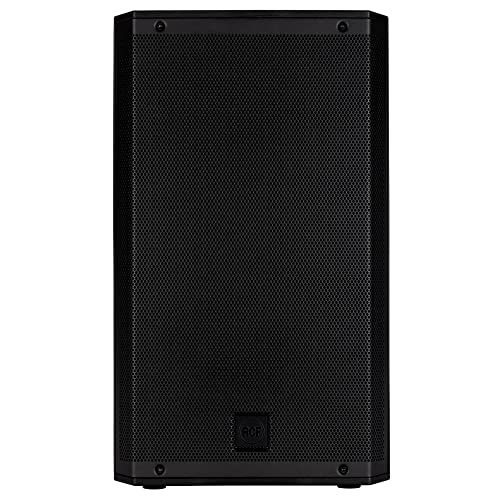
RCF ART 912-A 2,100W 12-inch Powered Speaker
$899.00 Specs and sizingA 2,100 watt Italian-built 12 that is noticeably more forward and detailed than most of its price class, which flatters a lead vocal.
Best for: Vocal-led worship where the lead voice must sit above the band
Check price on Amazon
Yamaha DXR12MKII, 12" 1100W Powered Speaker Cabinet
$909.99 Specs and sizingFIR-X crossover tuning and D-Contour processing that keeps a voice intelligible as level rises instead of letting it turn to mush.
Best for: Rooms where speech clarity at high level is the entire problem
Check price on AmazonWho should not buy this tier: Do not buy this tier for a room under 250 seats or for a portable rig carried weekly. These cabinets are heavier, and their advantage appears only at levels a small room cannot use. A volunteer team lifting them onto stands every week will find the weight a genuine problem.
When passive is the better answer
Powered speakers are not always right. Three situations favour passive boxes with a rack amplifier. First, where the church wants every amplifier in one lockable rack, because a locked rack cannot be tampered with and can be serviced in one place. Second, where running mains power to each speaker position is expensive or impossible, which is common in historic buildings. Third, where the system has many loudspeakers, since one amplifier channel per pair of small fills is cheaper than a powered box each.
There is also a maintenance argument. A failed amplifier module in a powered box means the box comes down off its bracket and goes away for repair. A failed rack amplifier is swapped in ten minutes with a spare from the cupboard. Churches with a single service and no spare often prefer that.
The alternatives are covered in the passive speaker roundup, and the long-term view on the top pick is in the K12.2 review. Electrical planning for either architecture is in electrical planning for church AV.
How we chose
We did not test these products in person and we never claim to. Picks are researched from manufacturer specification sheets and operator manuals, FCC rules where spectrum is involved, published standards, warranty terms, and the recurring themes in verified owner reviews. Every pick is matched to a real room size, seat count or input list rather than to a price bracket, and it is placed in the tier where its capability actually belongs. Where a product is wrong for most churches we say so on the page.
Sources
- Manufacturer published specifications, including coverage patterns and maximum sound pressure level
- Consensus of verified owner reviews across major retailers
Frequently asked questions
Are powered speakers better than passive for a church?
They are simpler, not better. A powered box has its amplifier matched and limited by the manufacturer, which removes both the matching arithmetic and the risk of driving a small amplifier into clipping. Passive systems win where the church wants all amplification in one lockable rack, where mains power at each speaker position is impractical, or where many small loudspeakers share a few amplifier channels.
What does the wattage figure on a powered speaker mean?
Usually peak power of the internal amplifier, which is roughly double the continuous figure and is not a measure of loudness. Two boxes with identical wattage can differ by several decibels in output depending on driver efficiency and horn design. Compare published maximum sound pressure level and coverage pattern instead, since those describe what the box actually does in a room.
Can powered speakers be flown from the ceiling?
Models with proper fly points can be, using rated hardware attached to structure that a structural engineer or certified rigger has approved. Models without fly points must never be suspended, whatever brackets are available. A flown powered speaker also needs a mains outlet at that height, installed by a licensed electrician, which is often the deciding cost.
Do we need the app control that these speakers advertise?
It is genuinely useful for setting delay, tuning and limiting once, then locking it so nobody changes it. It is not useful during a service, and it should not be relied on week to week. Where app control exists, set the configuration during commissioning, write the settings down, and use the physical presets as the everyday control.
How far apart should two main loudspeakers be?
Far enough to cover the seating width, close enough that listeners in the middle are not hearing two distinct sources. A common starting point is placing them just outside the platform edges and aiming them so their coverage crosses at roughly two thirds of the room depth. Very wide spacing leaves a weak centre, and narrow spacing wastes coverage on the walls.
Can the mains double as stage monitors?
Not well. Mains are aimed at the congregation, so musicians hear mostly reflections, and turning the mains up to help the platform makes the room too loud and invites feedback. Dedicated wedges or in-ear monitors solve the problem properly. A pole-mounted box laid on its side is not a wedge, since its pattern and voicing are wrong for that distance.
Researched, not professional advice. This page is compiled from published manufacturer specifications, operator manuals, FCC rules, published standards and owner-review consensus, not hands-on testing. Sound system design, rigging loudspeakers overhead, and any electrical work are jobs for a qualified professional: have flown loudspeakers and their attachment points signed off by a structural engineer or a certified rigger, and have all wiring done by a licensed electrician to your local code. Wireless microphone rules change, so confirm the current FCC position before buying. As an Amazon Associate we earn from qualifying purchases.