Processing
Best Loudspeaker Processors for Churches
Quick answer
The dbx DriveRack PA2 at $426.00 is the right processor for most churches, giving 2 inputs and 6 outputs of crossover, equalisation, delay and limiting in one rack unit. Churches with powered loudspeakers and no delay speakers usually need no separate processor at all.
A loudspeaker processor sits between the mixing console and the amplifiers and does four jobs: it splits the signal into frequency bands for the subwoofer and the mains, it equalises the system to the room, it delays outputs so distant speakers arrive in time, and it limits the signal so the drivers survive a volunteer. Everything else it offers is secondary.
Whether you need one depends entirely on what is downstream. Confirm your amplifier requirement in the amplifier power calculator, work out any delay speaker timing with the delay speaker timing calculator, and read how to tune a church sound system for what tuning actually involves once the box is in the rack.
On this page
Does your church need a loudspeaker processor?
Three questions settle it. Are the loudspeakers passive? Is there a subwoofer on a separate amplifier channel? Are there delay speakers or fill speakers anywhere in the room?
If the answer to all three is no, and the system is a pair of powered boxes with their own onboard processing, you do not need a separate processor and buying one adds a rack unit, a pair of cables and another thing to set wrongly. The DSP inside a modern powered loudspeaker already handles its own crossover and driver protection.
If the answer to any of them is yes, you need processing somewhere. The question then becomes where: inside the amplifier, or in its own box. An amplifier with onboard DSP such as the NX3000D or any of the Crown DriveCore models covers crossover, delay and limiting for a simple two way system, and costs nothing extra. A separate processor earns its rack unit once the output count passes what the amplifier offers, or once room tuning and feedback suppression are wanted in the same box.
What each processor actually does
The processing functions a church system needs, and which units in this catalog provide them.
The DriveRack PA2 covers every function a two way church system needs in one rack unit, while amplifiers with onboard DSP cover all of them except automatic room tuning.
| Function | What it is for | Amplifier DSP | {{p:dbx-driverack-pa2|DriveRack PA2}} | {{p:behringer-dcx2496|DCX2496}} |
|---|---|---|---|---|
| Crossover | Sends lows to the sub and highs to the mains | Yes | Yes | Yes |
| Limiting | Stops peaks reaching the drivers | Yes | Yes | Yes |
| Delay per output | Time aligns fills and delay speakers | Limited | Yes | Yes, on all six |
| Graphic and parametric EQ | Corrects the room response | Partly | Yes | Yes |
| Automatic room tuning | Sets a starting curve from a measurement mic | No | Yes | No |
| Feedback suppression | Notches ringing frequencies | No | Yes | No |
| Outputs available | How many speaker zones it can feed | 2 | 6 | 6 |
| Rack units | Space it consumes | 0 extra | 1 | 1 |
Automatic room tuning is a starting point and not a finished tune. It corrects broad response problems using a measurement microphone at a few positions, and it cannot correct reverberation, coverage gaps or a speaker aimed at a wall.
Small church: the processor you already own
A small church with a pair of powered speakers needs nothing here. A small church with passive speakers needs crossover and limiting, and the cheapest honest place to get them is inside the amplifier. Both of these have the processing built in, which saves a rack unit, a pair of cables and roughly four hundred dollars.

Crown XLS1002 2-Channel Class D DriveCore Professional Power Amplifier with DSP, Band Pass Filters & Peakx Limiters. XLR/RCA Inputs, 350W at 4 Ohm, PureBand Crossover System. Black
$439.88 Specs and sizingBand pass filters, a crossover system and peak limiting onboard, so a pair of passive mains gets its protection and its high pass filter without a separate box. For a speech-led small church this is the whole processing requirement.
Best for: A small passive system with no subwoofer and no fills
Check price on Amazon
Behringer NX3000D Ultra-Lightweight 3000 Watt Class-D Power Amplifier with DSP Control and SmartSense Loudspeaker Impedance Compensation
$339.00 Specs and sizingOnboard DSP with crossovers, delay and equalisation, which covers the crossover point between a passive subwoofer and the mains. That crossover is the single most valuable piece of processing a small contemporary church buys.
Best for: A passive main and subwoofer system on a budget
Check price on AmazonWho should not buy this tier: Systems with delay speakers, fill speakers or more than two output zones.
Mid-size: one processor, six outputs, a tuned room
This is where a dedicated processor pays for itself. A 150 to 500 seat room typically has mains, a subwoofer and a front fill for the first two rows, which is three output pairs, and it has never been equalised to the room. One unit that does the crossover, the tuning and the limiting is both cheaper and far easier for a volunteer to understand than three separate boxes.

dbx DriveRack PA2 2x6 PA Complete Professional Loudspeaker Management System, Rack Mountable with Android and iOS Control. Black
$426.00 Specs and sizingTwo inputs, six outputs, and an automatic tuning wizard that uses a measurement microphone to set a defensible starting curve. It also includes automatic feedback suppression, which covers the lectern microphone problem without a second box.
Best for: Any passive system, and any room that has never been tuned
Check price on Amazon
dbx 231s Dual Channel 31-Band Equalizer
$335.00A dual channel 31 band graphic equaliser, which does one part of the job with physical faders that an older volunteer can see and understand. Pair it with amplifier DSP if the team will not touch software.
Best for: Traditional installs and teams more comfortable with faders than screens
Check price on AmazonWho should not buy this tier: Rooms with three or more delay rings, which need per-output delay on every output.
Large room: delay rings and multiple zones
Past roughly 70 feet of throw a room needs delay speakers, and delay speakers need per-output delay computed from the distance between the mains and the fills. Get it wrong and the fill arrives before or noticeably after the mains, which is worse than having no fill at all. The arithmetic is in the delay speaker timing calculator and the design in under balcony delay speakers.
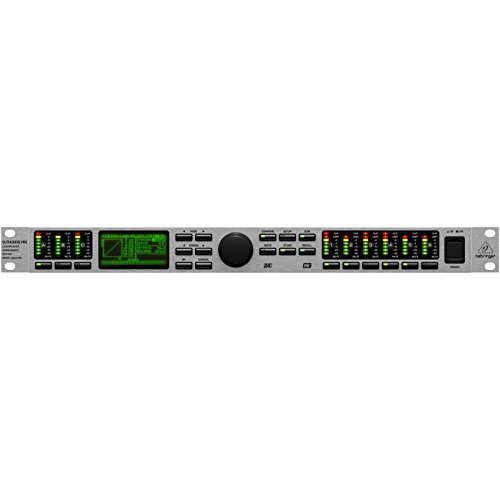
Behringer Ultradrive Pro Dcx2496 Ultra High-Precision Digital 24-Bit/96 Khz Loudspeaker Management System
$339.00 Specs and sizingThree inputs and six outputs with crossover, delay, equalisation and limiting available independently on every output, which is what a system with mains, subwoofers and a delay ring actually requires. One rack unit for the whole loudspeaker design.
Best for: Systems with under-balcony or mid-room delay speakers to time align
Check price on AmazonWho should not buy this tier: Do not buy this tier for a system with two outputs and no fills. Six outputs of independent processing is a configuration burden, not a feature, when four of them will never be connected, and a volunteer is far more likely to leave a wrong delay in a box like this than in a simpler unit.
The processors compared
| Model | Price | Video inputs | Video outputs | Rack space | Onboard DSP |
|---|---|---|---|---|---|
| dbx DriveRack PA2 2x6 PA Complete Professional Loudspeaker Management System, Rack Mountable with Android and iOS Control. Black | $426.00 | 2 | 6 | 1U | Yes |
| Behringer Ultradrive Pro Dcx2496 Ultra High-Precision Digital 24-Bit/96 Khz Loudspeaker Management System | $339.00 | 3 | 6 | 1U | Yes |
| dbx 231s Dual Channel 31-Band Equalizer | $335.00 | 2 | 2 | 2U | - |
Setting the crossover point without a designer
- Read the published low frequency limit of your mains. Take the manufacturer figure for the main loudspeaker, not a guess. A 12 inch two way cabinet typically publishes a usable response starting somewhere between 50 and 65 Hz.
- Set the crossover about half an octave above that. A crossover at 80 to 100 Hz is the usual answer for a 12 or 15 inch main with a subwoofer underneath it. Below that the mains work harder than they should, above it the subwoofer starts to become locatable.
- High pass the mains, low pass the subwoofer, at the same frequency. Both filters go at the same point with matching slopes, typically 24 dB per octave. A gap between them leaves a hole in the low mids, and an overlap makes that octave boom.
- Check polarity by ear at the crossover point. Play programme material with content in that octave and flip the subwoofer polarity switch. Whichever setting is louder and fuller at the crossover frequency is correct, and the difference is usually obvious.
- Set the limiters last, from the amplifier rating. Limiter thresholds protect the drivers, so they are set from the loudspeaker power handling and the amplifier output, and they are set once and left alone.
How we chose
We did not test these products in person and we never claim to. Picks are researched from manufacturer specification sheets and operator manuals, FCC rules where spectrum is involved, published standards, warranty terms, and the recurring themes in verified owner reviews. Every pick is matched to a real room size, seat count or input list rather than to a price bracket, and it is placed in the tier where its capability actually belongs. Where a product is wrong for most churches we say so on the page.
Sources
- Manufacturer published specifications for each processor listed
- Consensus of verified owner reviews across major retailers
Frequently asked questions
Do powered speakers need a loudspeaker processor?
Usually not. A powered loudspeaker contains its own crossover, equalisation and driver protection, tuned by the manufacturer for that exact cabinet. A separate processor becomes useful only when you add a subwoofer that needs a crossover point set, or fill speakers that need delay. Adding one to a simple pair of powered boxes mostly adds a way to make the system sound worse.
What is the difference between a processor and a graphic equaliser?
A graphic equaliser adjusts level in fixed frequency bands and does nothing else. A loudspeaker processor includes equalisation plus the crossover, the delay and the limiting, which are the functions that protect the drivers and time align the system. A graphic equaliser alone cannot split a signal between a subwoofer and the mains, which is the job that actually requires a processor.
Can a processor fix a bad sounding room?
It can correct broad tonal problems and it cannot correct reverberation, coverage gaps or reflections. Equalisation changes what the loudspeaker sends, not what the room does to it afterwards. If speech is unintelligible in a hard-surfaced sanctuary, absorption and tighter pattern control are the fix, and a processor set to compensate will simply make the system sound thin.
Should the processor go before or after the mixer?
After. The signal chain runs console output, processor, amplifier, loudspeaker. The processor is protecting and correcting the loudspeaker system, so anything that changes after it is invisible to it. Putting it in front of the console, or inserting it on a channel, removes the protection the limiters were providing to the drivers.
Is automatic room tuning good enough?
It is a good starting point and not a finished result. The wizard on the DriveRack takes measurements from a few positions and sets a broad correction curve, which is far better than the untuned system a volunteer-run church usually has. A system designer with proper measurement software will do better, and most churches will not pay for that every year.
How much delay do under-balcony speakers need?
Roughly one millisecond per foot of distance between the main loudspeaker and the delay speaker, plus a few milliseconds so the direct sound clearly arrives first. Sound travels about 1,130 feet per second in a warm room. Getting this wrong makes speech less intelligible rather than more, which is why the delay calculator exists.
Researched, not professional advice. This page is compiled from published manufacturer specifications, operator manuals, FCC rules, published standards and owner-review consensus, not hands-on testing. Sound system design, rigging loudspeakers overhead, and any electrical work are jobs for a qualified professional: have flown loudspeakers and their attachment points signed off by a structural engineer or a certified rigger, and have all wiring done by a licensed electrician to your local code. Wireless microphone rules change, so confirm the current FCC position before buying. As an Amazon Associate we earn from qualifying purchases.