Amplification
Best Power Amplifiers for Churches
Quick answer
A church amplifier should be rated 1.6 to 2 times the continuous power of the loudspeaker it drives, so a pair of 250 watt passive mains wants roughly 400 to 500 watts per channel at 8 ohms. The Crown XLS 2502 at $843.98 meets that for most mid-size sanctuaries.
An amplifier only matters in a system with passive loudspeakers. If the boxes are powered, the amplifier is already inside them and this page is not your purchase. If the loudspeakers are passive, the amplifier is the single component most often bought too small, and the consequences are more expensive than the saving.
Work the requirement from your own room first with the amplifier power calculator, which turns seat count and throw distance into watts per box. Then check the cable run, because a long run of thin cable gives back power the amplifier just produced. The architecture question, powered against passive, is settled in powered against passive speakers and is worth settling before you order anything.
On this page
Why an undersized amplifier destroys loudspeakers
The intuition most committees bring to this decision is backwards. A small amplifier feels like the safe, conservative choice, and it is the choice that burns out compression drivers.
Here is the mechanism. When an amplifier runs out of voltage swing, it clips: the tops and bottoms of the waveform flatten. A flattened waveform is no longer music, it is something much closer to sustained direct current, and its energy shifts heavily into the high frequencies. The compression driver on a typical two way loudspeaker is designed to handle short high frequency transients, perhaps a fifth of the cabinet rating, and it has almost no thermal mass. Feed it sustained clipped output and the voice coil overheats in seconds. A larger amplifier, operated with its gain set sensibly, never clips and never sends that signal at all.
So the rule is an amplifier rated 1.6 to 2 times the continuous power handling of the loudspeaker at the impedance it will actually see. The headroom is not there to be used. It is there so the peaks in speech and music, which run 10 to 12 dB above the average level, arrive undistorted. Set the gain so the system reaches its loudest needed level before the amplifier clip light ever flickers, then leave it. That procedure is set out in gain structure for church sound.
What amplifier does each loudspeaker need?
Continuous power handling from the loudspeaker catalog, the target amplifier power at 1.6 to 2 times that figure, and the amplifier that meets it. All amplifier figures are published per channel ratings.
A 250 watt passive main needs 400 to 500 watts per channel at 8 ohms, which is the Crown XLS 2502 rather than the smaller models most churches reach for first.
| Passive loudspeaker | Continuous rating | Target amplifier power | Amplifier that meets it | Published output |
|---|---|---|---|---|
| ZLX-12 G2 passive | 250 W at 8 ohms | 400 to 500 W | XLS 2502 | 440 W at 8 ohms |
| One pair per channel, 4 ohm load | 500 W combined | 800 to 1,000 W | XLS 2502 | 775 W at 4 ohms |
| PRX412M wedge | 400 W at 8 ohms | 640 to 800 W | NX6000D | 3,000 W at 4 ohms |
| JRX218S passive sub | 350 W at 8 ohms | 560 to 700 W | NX3000D | 1,500 W at 4 ohms |
| Control 25-1 pair | 100 W each | 160 to 200 W | XLS 1002 | 215 W at 8 ohms |
| Control 416C/T ceiling | 50 W tapped | Use a 70 volt amplifier | CDi 1000 | 500 W at 70 volts |
Two 8 ohm cabinets wired in parallel on one channel present a 4 ohm load, which is why the 4 ohm column matters more than the 8 ohm one in most real systems. Never wire three or more 8 ohm cabinets in parallel on a single channel without checking the amplifier minimum impedance, and never bridge an amplifier into a load below its bridged rating.
Small church: one amplifier, two passive mains
Under about 150 seats the whole amplification requirement is one two channel amplifier in one rack unit. What matters at this size is not power but protection and processing: onboard crossovers and limiters mean a volunteer who pushes the system too far gets a limiter working rather than a repair bill. Both options here weigh under ten pounds, which also means a spare can live on a shelf.

Crown XLS1002 2-Channel Class D DriveCore Professional Power Amplifier with DSP, Band Pass Filters & Peakx Limiters. XLR/RCA Inputs, 350W at 4 Ohm, PureBand Crossover System. Black
$439.88 Specs and sizingA published 215 watts per channel at 8 ohms with crossovers, band pass filters and peak limiting built in, in one rack unit at 8.6 pounds. For a pair of small passive mains it is enough power with the headroom rule respected.
Best for: A pair of passive mains in a room up to about 150 seats
Check price on Amazon
Behringer NX1000 Ultra-Lightweight 1000 Watt Class-D Power Amplifier with SmartSense Loudspeaker Impedance Compensation
$259.00 Specs and sizingThree hundred watts per channel at 8 ohms with impedance compensation, at a price where a church can buy a second one and keep it in the closet. A spare amplifier turns a dead Sunday into a five minute swap.
Best for: A tight budget, or the backup that lives on the shelf
Check price on AmazonWho should not buy this tier: Rooms where the loudspeakers are already powered, since those have their amplifiers built in.
Mid-size: 150 to 500 seats, mains plus a subwoofer
This is the size where the amplifier stops being an afterthought. The system usually has passive mains and a subwoofer, which means two different power requirements and a crossover point between them. Two routes work: one amplifier per pair of boxes with processing in a separate unit, or an amplifier with the processing already inside. The second is cheaper and takes less rack space, and the first is easier to expand later.
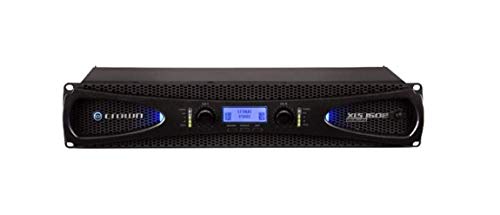
Crown XLS1502 2-Channel Class D DriveCore Professional Power Amplifier with DSP, Band Pass Filters & Peak Limiters. XLR/RCA Inputs, 525W at 4 Ohm, PureBand Crossover System. Black
$579.99 Specs and sizingThree hundred watts per channel at 8 ohms, 525 at 4, with crossover, delay and limiting onboard. One rack unit driving a pair of mains, with the delay function available if a fill speaker is added later.
Best for: A 150 to 400 seat room with passive mains and no separate processor
Check price on Amazon
Crown XLS2002 2-Channel Class D DriveCore Professional Power Amplifier with DSP, Band Pass Filters & Peakx Limiters. XLR/RCA Inputs, 650W at 4 Ohm, PureBand Crossover System. Black
$629.96 Specs and sizingA published 375 watts per channel at 8 ohms and 650 at 4, which is the step to take when the mains are rated above about 300 watts each or when one channel has to feed a subwoofer.
Best for: Larger passive mains, or one channel to the mains and one to a sub
Check price on Amazon
Behringer NX3000D Ultra-Lightweight 3000 Watt Class-D Power Amplifier with DSP Control and SmartSense Loudspeaker Impedance Compensation
$339.00 Specs and sizingA published 1,500 watts per channel at 4 ohms with onboard DSP covering crossovers, delay and equalisation, which is the processing a simple two way system needs. The sensible use is one channel to a passive subwoofer.
Best for: A passive main and subwoofer system with no separate loudspeaker processor
Check price on AmazonWho should not buy this tier: Distributed ceiling systems, which need a 70 volt amplifier instead.
Large room or multi-campus: 500 seats and up
In a large room the amplifier rack carries several channels with different jobs: mains, subwoofers, front fills and often a delay ring under a balcony. The decisions that matter here are headroom, impedance loading and heat. Racks fail from heat far more often than from electrical fault, so leave a vented unit above each amplifier and never pack a rack solid. The delay speaker timing question is covered in under balcony delay speakers.

Crown XLS2502 2-Channel Class D DriveCore Professional Audio Power Amplifier with DSP, Band Pass Filters & Peakx Limiters. XLR/RCA Inputs, 775W at 4 Ohm, PureBand Crossover System. Black
$843.98 Specs and sizingA published 440 watts per channel at 8 ohms and 775 at 4, the largest of the XLS line. This is the amplifier that actually satisfies the 1.6 to 2 times rule for a 250 watt main, which smaller models in the same family do not.
Best for: Passive mains in a 500 seat and up sanctuary, or a passive subwoofer pair
Check price on Amazon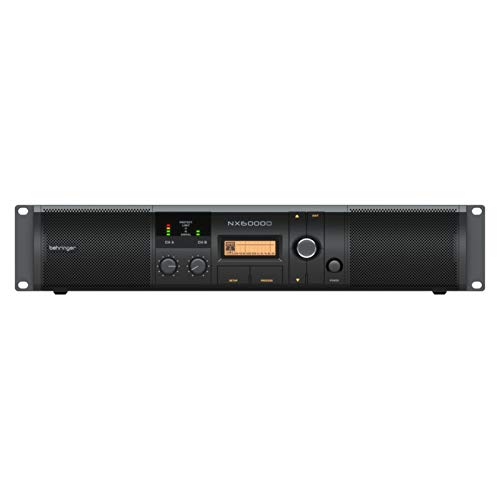
Behringer NX6000D Power Amplifier
$519.00 Specs and sizingA published 3,000 watts per channel at 4 ohms with the same DSP section as the smaller model, which is the power a pair of passive 18 inch subwoofers in a large contemporary room actually asks for.
Best for: Driving passive subwoofers in a large room
Check price on Amazon
Crown CDi 2000 Two-Channel, 800-Watt @ 4Ω, 70V/140V Power Amplifier
$1,125.00 Specs and sizingEight hundred watts per channel at 4 ohms and direct 70 volt and 140 volt outputs on the same box, so one amplifier can serve a low impedance pair in the sanctuary and a 70 volt line to the foyer and nursery.
Best for: Multi-zone buildings where one rack feeds several rooms
Check price on AmazonWho should not buy this tier: Do not buy this tier for a room under about 250 seats or for a system with powered loudspeakers. In a small room the extra headroom is never used, the amplifier runs at a fraction of its rating and the money would have bought better microphones. With powered boxes it is simply redundant, since the amplifier is already in the cabinet.
The amplifiers compared
What a bigger amplifier will not fix
More power will not make a room more intelligible. If speech is hard to follow in a stone or plaster sanctuary the cause is reverberation, and a louder system excites the room harder. The fix is pattern control and absorption rather than watts.
More power will not fix coverage either. If the back row cannot hear, the problem is usually that the loudspeaker pattern does not reach it, and adding watts makes the front rows painful long before the back becomes clear. That is a placement and aiming problem, covered in how to aim and place church speakers and often a delay speaker problem.
Finally, an amplifier will not rescue a system with the wrong processing. If the crossover point is wrong, the subwoofer and mains fight each other in the octave they share, and no amount of power sorts that out. That is what a loudspeaker processor exists to do.
How we chose
We did not test these products in person and we never claim to. Picks are researched from manufacturer specification sheets and operator manuals, FCC rules where spectrum is involved, published standards, warranty terms, and the recurring themes in verified owner reviews. Every pick is matched to a real room size, seat count or input list rather than to a price bracket, and it is placed in the tier where its capability actually belongs. Where a product is wrong for most churches we say so on the page.
Sources
- Manufacturer published specifications for each amplifier listed
- Loudspeaker continuous power ratings as published by each manufacturer
- Consensus of verified owner reviews across major retailers
Frequently asked questions
Can an amplifier be too powerful for a church speaker?
Practically, no. A larger amplifier operated with sensible gain simply never clips, and the loudspeaker sees clean peaks rather than flattened ones. The risk with a large amplifier is a volunteer turning it up past what the driver can take, which is what the onboard limiters on every amplifier listed here exist to prevent. The far more common failure is an undersized amplifier clipping into a compression driver.
How many watts does a church sound system need?
It follows from throw distance and target level rather than seat count alone. A 250 seat room with a 62 foot throw needs roughly 420 watts per box for a blended service at 88 dBA with 12 dB of peak headroom, so the amplifier wants about 700 watts per channel. A small chapel may need under 150 watts per box. The amplifier power calculator works it from your own measurements.
Do powered speakers still need an amplifier?
No. A powered or active loudspeaker has its amplifier and processing built into the cabinet, so it needs a signal cable and a mains outlet and nothing else. That is the main reason churches choose them. The trade is a power outlet at every speaker position, which in an older building can be the more expensive half of the job.
Can one amplifier channel drive two speakers?
Yes, if the combined impedance stays at or above the amplifier minimum. Two 8 ohm cabinets in parallel present 4 ohms, which every amplifier here handles. Four in parallel present 2 ohms, which many do not. Series and parallel wiring, and the cable gauge that keeps losses under about four tenths of a decibel, are covered in the speaker cable gauge chart.
What does bridging an amplifier do?
Bridging combines both channels into one higher power mono output, typically used for a single subwoofer. The catch is that a bridged amplifier sees half the load impedance, so an 8 ohm speaker looks like 4 ohms and a 4 ohm speaker looks like 2. Check the published bridged minimum impedance before wiring it, because bridging into too low a load is a reliable way to shut an amplifier down mid service.
How long do power amplifiers last in a church?
Fifteen to twenty years is normal in a ventilated rack in a climate-controlled room, because a class D amplifier has no wearing parts apart from its fans and electrolytic capacitors. Heat is what shortens that. A rack packed solid with no vented space above each amplifier is the most common reason a church amplifier dies early, and it is entirely avoidable.
Researched, not professional advice. This page is compiled from published manufacturer specifications, operator manuals, FCC rules, published standards and owner-review consensus, not hands-on testing. Sound system design, rigging loudspeakers overhead, and any electrical work are jobs for a qualified professional: have flown loudspeakers and their attachment points signed off by a structural engineer or a certified rigger, and have all wiring done by a licensed electrician to your local code. Wireless microphone rules change, so confirm the current FCC position before buying. As an Amazon Associate we earn from qualifying purchases.