Monitoring
Best In-Ear Monitors for Church Musicians
Quick answer
Start with the drummer and the worship leader, who between them account for most of the stage volume problem. A drummer needs isolation above all, which means sealed earphones such as the SE215 at $119, and a fixed position that can be wired rather than wireless.
Most in-ear advice treats a worship band as one purchase. It is not. A drummer sitting inside the loudest instrument in the building has an isolation problem, an acoustic guitarist has a feedback problem, a roaming vocalist has a range problem, and a keyboard player who never moves has no wireless requirement at all. Buying the same system for all of them wastes money on some positions and fails others. This page works position by position. For the whole platform view see how to mic a worship band, and size the mixes with the monitor mix calculator.
On this page
- What each platform position actually needs
- Small church: the drummer and nobody else, $40 to $160
- Mid-size church: vocalists on wireless, $499 to $989
- Large band or multi-campus: $203 to $1,649 per position
- Why the drummer comes first
- What each position should be given
- Getting musicians to accept in-ears
What each platform position actually needs
The useful question for each musician is not which system, but whether they move and how much acoustic noise they sit inside. Those two answers give you the right product almost every time, and they frequently give a cheaper answer than a wireless system for everybody.
Only the vocalists genuinely need wireless in-ears, so a five piece band can usually be served with two wireless systems and three wired positions.
| Position | Moves? | Acoustic noise around them | What they need | Wireless required |
|---|---|---|---|---|
| Drummer | No | Extreme, inside the kit | Maximum isolation, click and bass | No |
| Bass player | Rarely | High | Isolation, kick and click | No |
| Keyboard player | No | Moderate | Own instrument, vocals, click | No |
| Acoustic guitarist | Sometimes | Moderate | Vocal clarity, own instrument | Only if they move |
| Worship leader | Yes | Moderate | Own vocal, band balance, click | Yes |
| Backing vocalists | Sometimes | Moderate | Vocal blend, often a shared mix | Yes if they move |
Wired positions can use a belt clip amplifier on an aux send or a personal mixer, both of which cost a fraction of a wireless system and cannot drop out. Reserve wireless channels for people who genuinely walk, because each one consumes spectrum your microphones also need.
Small church: the drummer and nobody else, $40 to $160
If a church can only change one thing, it should be the drummer. The kit is the loudest source on the platform, the drummer is the person least able to hear anything else, and a drummer on in-ears stops needing a wedge turned up to compete with their own snare. Because the drum stool never moves, this position does not need a wireless system at all, which makes it the cheapest meaningful upgrade available.

Behringer P2 Ultra-Compact Personal In-Ear Monitor Amplifier
$39.90A belt clip headphone amplifier fed from an aux send on XLR. At about $40 it turns a spare console output into a proper wired in-ear mix for a fixed position.
Best for: The drummer, the keyboard player and anyone who never moves
Check price on Amazon
Shure SE215 PRO Wired Earbuds - Professional Sound Isolating Earphones, Clear Sound & Deep Bass, Single Dynamic MicroDriver, Secure Fit In Ear Monitor, plus Carrying Case & Fit Kit - Clear (SE215-CL)
$119.00Roughly 37 dB of isolation, which is the working part of in-ear monitoring. Paired with a $40 belt amplifier this is a complete, genuinely effective in-ear position for under $160.
Best for: Every musician moving from wedges to in-ears
Check price on Amazon
Behringer POWERPLAY P1 Personal In-Ear Monitor Amplifier
$55.90A wired personal monitor amplifier with a stereo or mono switch and a limiter, designed to sit on a fixed position such as the drum riser or the keyboard.
Best for: A position that never moves and wants a limiter
Check price on AmazonWho should not buy this tier: Vocalists who walk the platform, who need a wireless bodypack rather than a belt clip amplifier on a cable.
Mid-size church: vocalists on wireless, $499 to $989
Once the fixed positions are handled cheaply, the wireless budget goes to the people who actually move. A worship leader who walks needs a bodypack, and so does a backing vocalist who steps forward. This is also where a church should standardise on one platform so that packs, earphones and spares are interchangeable across the whole band.

Shure PSM300 P3TRA215CL Pro Wireless in-Ear Personal Monitoring System with SE215-CL Earphones
$989.00 Specs and sizingA complete wireless system with earphones that isolate properly. Standardising the whole band on one platform means a failed pack is swapped rather than diagnosed.
Best for: The worship leader and anyone who moves while singing
Check price on Amazon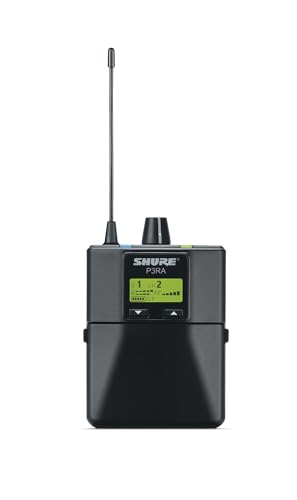
Shure P3RA Premium Wireless Bodypack Receiver for PSM300 Personal Monitoring Systems - G20 Band
$499.00A metal bodied bodypack receiver on its own, which adds a listener to an existing transmitter for half the cost of a new system.
Best for: Adding a second listener to a mix that already exists
Check price on Amazon
Shure PSM300 Twin Pack Pro Wireless in-Ear Monitor System - G20
$1,539.00 Specs and sizingOne transmitter and two packs, for two vocalists who accept the same balance. One frequency instead of two, which matters once the RF plan is filling up.
Best for: A pair of backing vocalists
Check price on AmazonWho should not buy this tier: Bands of seven or more, where wired personal mixers become substantially cheaper and remove the spectrum problem.
Large band or multi-campus: $203 to $1,649 per position
A large band changes the arithmetic twice over. Wireless becomes expensive per mix and spectrum becomes genuinely scarce, so the efficient answer is usually a hybrid: wired personal mixers for the six or seven musicians who stay put, and a small number of wireless systems for the people who move. That is the configuration most large churches converge on, and it is cheaper than either approach alone.

Behringer Powerplay P16-HQ 16-Channel Digital Personal Monitoring Mixer
$203.99Sixteen channels of personal mix control at each position over one Cat5 cable, with a better headphone amplifier than the older revision. Past about six mixes this is far cheaper than wireless and uses no spectrum at all.
Best for: Six or more musicians who each want their own mix
Check price on Amazon
Behringer POWERPLAY P16-D 16 Channel Digital ULTRANET Distributor
$139.00The distributor that splits one feed to eight personal mixers and powers them down the same cable, so no position needs a power outlet.
Best for: Any personal mixer system with more than two positions
Check price on Amazon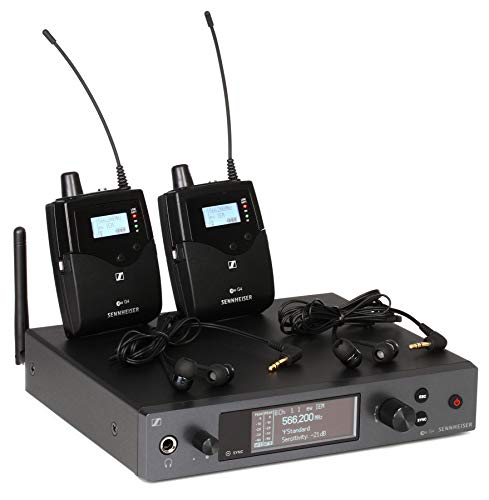
Sennheiser Pro Audio Sennheiser ew IEM G4-Twin-G in Ear Monitor System w/ 2 Belt Packs Range (566-608Mhz), Dual Beltpack
$1,649.00 Specs and sizingOne transmitter and two bodypacks with a wide tuning range, for the vocalists who genuinely need to walk in a building where the frequency plan is already crowded.
Best for: Two roaming musicians on a shared mix in a dense RF environment
Check price on AmazonWho should not buy this tier: A four piece band in a 200 seat church. A personal mixer system needs cabling, a distributor and a console that can feed it, and the setup cost is not repaid at that size. Two wireless systems and two belt amplifiers would serve the same band for less than half the money.
Why the drummer comes first
A drum kit produces well over 100 dB at the drummer’s position, which means the drummer cannot hear the band without a wedge loud enough to be heard over their own kit. That wedge is then the loudest thing on the platform, it bleeds into every vocal microphone, and it sets the floor for how quiet the room can be. Putting the drummer on sealed in-ears breaks that chain in a single step.
It is also the cheapest step, because the drum stool does not move. A belt clip amplifier and a pair of isolating earphones is under $160 against roughly $800 for a wireless system that would deliver no additional benefit to someone sitting still. The same logic applies to bass and keyboards. For the fuller argument see in-ears versus floor wedges and reducing stage volume.
What each position should be given
Getting musicians to accept in-ears
The transition fails for predictable reasons and they are mostly human rather than technical. Musicians report feeling disconnected from the room, which is real: a sealed earphone removes the congregation entirely, so a band that could previously hear people singing now hears nothing. The fix is an ambient microphone or two into the monitor mixes, which restores the room without restoring the volume.
The second objection is that in-ears sound thin, which almost always means one earphone is not sealing or the mix is mono with everything in it at once. Fit matters more than price here. The third is that someone wants to keep one ear out, which defeats the isolation entirely and pushes them to run the other side dangerously loud. Address all three before concluding that a band will not accept in-ears, and see how to set up in-ear monitors for the process.
How we chose
We did not test these products in person and we never claim to. Picks are researched from manufacturer specification sheets and operator manuals, FCC rules where spectrum is involved, published standards, warranty terms, and the recurring themes in verified owner reviews. Every pick is matched to a real room size, seat count or input list rather than to a price bracket, and it is placed in the tier where its capability actually belongs. Where a product is wrong for most churches we say so on the page.
Sources
- Shure published specifications for the SE215 earphones, PSM300 system and P3RA bodypack
- Behringer published specifications for the Powerplay P2, P1, P16-M and P16-HQ
- Sennheiser published specifications for the ew IEM G4 Twin system
Frequently asked questions
Which musician should get in-ear monitors first?
The drummer. A drum kit is the loudest source on the platform and the drummer needs a wedge loud enough to compete with it, which then bleeds into every vocal microphone and sets the volume floor for the whole room. Because the drum stool never moves, this position can be wired rather than wireless, making it the cheapest meaningful improvement available.
Do all our musicians need wireless in-ear systems?
No, and assuming so is the most common way churches overspend. Only musicians who genuinely walk need wireless. A drummer, bassist or keyboard player sitting in one place is served just as well by a belt clip amplifier on an aux send, at around $40 rather than $800, with no battery, no frequency and no possibility of dropout.
Why do musicians say in-ear monitors feel disconnecting?
Because a sealed earphone removes the room completely, so a band that used to hear the congregation singing now hears nothing but the mix. This is a genuine complaint with a straightforward fix: place one or two ambient microphones in the room and feed them into the monitor mixes. That restores the sense of the congregation without restoring the stage volume.
Can musicians use their own earbuds with a church in-ear system?
They can, and it usually undermines the purpose. Consumer earbuds rarely seal properly, so the musician still hears the platform acoustically and raises the mix to compete, which is both unpleasant and a hearing risk. Sealed monitoring earphones providing around 37 dB of isolation are what make in-ears work. Budget them as part of the system.
Should in-ear mixes be stereo or mono?
Mono suits most musicians and halves the console outputs required, which is why personal mixers and belt amplifiers commonly offer a mono switch. Stereo is worth the extra output for the worship leader and anyone running a click track alongside backing tracks, where separating the click from the music makes it far easier to follow at a lower level.
Is it safe for musicians to wear only one earphone?
It is a common habit and a poor one. Removing one earphone destroys the isolation the system depends on, so the musician raises the remaining side to hear over the room, which concentrates a high level into one ear. If someone wants room awareness, the correct answer is ambient microphones in the mix rather than an open ear.
Researched, not professional advice. This page is compiled from published manufacturer specifications, operator manuals, FCC rules, published standards and owner-review consensus, not hands-on testing. Sound system design, rigging loudspeakers overhead, and any electrical work are jobs for a qualified professional: have flown loudspeakers and their attachment points signed off by a structural engineer or a certified rigger, and have all wiring done by a licensed electrician to your local code. Wireless microphone rules change, so confirm the current FCC position before buying. As an Amazon Associate we earn from qualifying purchases.