Ceiling speaker spacing
How Far Apart Should Ceiling Speakers Be at 22 Feet?
Quick answer
With a 22 foot ceiling and a typical 90 degree ceiling speaker, each speaker covers a circle about 36 feet across at seated ear height. Space them 36 feet apart for edge to edge coverage, 25.5 feet apart for minimum overlap, which is the normal choice for speech, or 18 feet apart for tight overlap where intelligibility is critical.
Ceiling speaker spacing comes from one piece of geometry: the cone of sound a speaker throws widens as it travels, so the coverage circle at the listener depends on how far the listener is below the speaker. That is not the ceiling height. It is the ceiling height minus ear height, which is about 4 feet for a seated congregation and 5 feet for a standing one. Measuring to the floor instead is the single most common ceiling-speaker mistake and it over-states coverage by a third in a 22 foot room, which is how rooms end up with dead spots between the seats.
On this page
- What is the coverage formula for a 22 foot ceiling?
- Spacing at 22 feet by speaker coverage angle
- How many ceiling speakers does a room with a 22 foot ceiling need?
- When a ceiling system is the wrong answer
- Wiring the system: 70 volt or 8 ohm?
- Amplifiers with a 70 volt output
- Ceiling speakers that suit a 22 foot ceiling
What is the coverage formula for a 22 foot ceiling?
Coverage diameter is D = 2 x (ceiling height - ear height) x tan(coverage angle / 2). At 22 feet with a seated listener at 4 feet, the speaker is 18 feet above the ear plane, so a 90 degree speaker covers 36 feet across.
Spacing is then a fraction of that diameter, and the fraction is the layout choice:
- Edge to edge, spacing equals D. The circles just touch. Cheapest, leaves gaps at the diagonals, fine for background music and paging.
- Minimum overlap, spacing equals D divided by 1.41. The circles cross at the corners of the grid so every point is covered. This is the normal choice for speech reinforcement.
- Tight overlap, spacing equals D divided by 2. Even coverage everywhere, used where intelligibility is critical or the ceiling is very high.
Run your own numbers in the ceiling speaker spacing calculator.
Spacing at 22 feet by speaker coverage angle
Coverage angle is the speaker's published conical dispersion, and it is usually quoted at 2 kHz or 4 kHz. Most 70 volt ceiling speakers are 90 degrees. If a data sheet quotes the 500 Hz figure it will look far wider than the speaker really is at the frequencies that carry speech, so check which frequency the number refers to.
At a 22 foot ceiling, a 90 degree ceiling speaker covers 36 feet and should sit 25.5 feet from its neighbour for speech.
| Coverage angle | Coverage diameter | Edge to edge | Minimum overlap | Tight overlap |
|---|---|---|---|---|
| 60 degrees | 20.8 ft | 20.8 ft | 14.7 ft | 10.4 ft |
| 75 degrees | 27.6 ft | 27.6 ft | 19.5 ft | 13.8 ft |
| 90 degrees | 36 ft | 36 ft | 25.5 ft | 18 ft |
| 110 degrees | 51.4 ft | 51.4 ft | 36.4 ft | 25.7 ft |
| 120 degrees | 62.4 ft | 62.4 ft | 44.1 ft | 31.2 ft |
Measured to a seated ear height of 4 feet. For a standing congregation use 5 feet, which shrinks every figure here by about 11 percent per foot of difference.
How many ceiling speakers does a room with a 22 foot ceiling need?
Speaker count for four common room sizes, using 90 degree speakers at minimum overlap, which is the right default for a room where people have to understand words.
A 40 by 60 foot room with a 22 foot ceiling needs about 6 ceiling speakers on a 25.5 foot grid.
| Room | Area | Grid | Speakers | Spacing | Area each |
|---|---|---|---|---|---|
| 30 by 40 ft | 1,200 sq ft | 2 by 2 | 4 | 25.5 ft | 300 sq ft |
| 40 by 60 ft | 2,400 sq ft | 2 by 3 | 6 | 25.5 ft | 400 sq ft |
| 50 by 80 ft | 4,000 sq ft | 2 by 4 | 8 | 25.5 ft | 500 sq ft |
| 60 by 100 ft | 6,000 sq ft | 3 by 4 | 12 | 25.5 ft | 500 sq ft |
Set the first row half a spacing from each wall, so the perimeter speakers are not firing into the wall and the grid stays centred in the room.
When a ceiling system is the wrong answer
Worth saying plainly, because it costs sales and it is true: a distributed ceiling system is excellent for the spoken word and poor for a worship band. Ceiling speakers fire straight down, so they put almost no direct sound on a listener from the direction of the platform, which means the congregation hears music from above and the band from in front. That split is disorienting and no amount of processing fixes it.
A 22 foot ceiling makes this worse, because the speakers are far enough away that the room hears more reflection than direct sound. Use a ceiling system for a fellowship hall, an overflow room, a chapel, corridors and the nursery, and put a point-source or line-array system in the sanctuary. Where a church genuinely has no option, a ceiling system with a stereo pair over the platform area at least gives some directional anchor.
Wiring the system: 70 volt or 8 ohm?
Above about four speakers, run the system at 70 volts. A constant-voltage line lets you tap each speaker at a fixed wattage and hang as many as the amplifier budget allows on one pair of wires, instead of solving an impedance puzzle every time somebody adds a speaker. Size the amplifier at the sum of the taps divided by 0.8, so there is headroom to add a speaker later without replacing the amplifier. The 70 volt system calculator does the arithmetic.
Below four speakers in one small room, plain 8 ohm wiring is simpler and slightly more efficient, because there is no transformer in the path.
Amplifiers with a 70 volt output
A distributed ceiling system needs an amplifier with a direct 70 volt output, not a standard low-impedance amplifier with a transformer bolted on.

Crown CDi 1000 Two-Channel, 500-Watt @ 4Ω, 70V/140V Power Amplifier
$1,487.52 Specs and sizingA true install amplifier with direct 70V and 140V outputs, so a distributed ceiling system needs no output transformer of its own.
Best for: Any 70V ceiling or distributed system
Check price on Amazon
Crown CDi 2000 Two-Channel, 800-Watt @ 4Ω, 70V/140V Power Amplifier
$1,125.00 Specs and sizingThe larger CDi, for a 70V line long enough or dense enough that 500 watts per channel runs out of tap budget.
Best for: Large distributed systems, or a 70V line shared with several ancillary rooms
Check price on AmazonCeiling speakers that suit a 22 foot ceiling
At 22 feet, prefer a narrower pattern and a higher power tap. A wide speaker this high covers a very large circle at a very low level, which reads as muddy rather than loud.

JBL Professional Control 47HC High Ceiling Loudspeaker, Sold as Pair
$794.00 Specs and sizingThe high-ceiling version, with a narrower 75 degree pattern so the coverage circle does not become uselessly large from twenty feet up.
Best for: Ceilings above about sixteen feet, where a 90 degree speaker covers too much and too thinly
Check price on Amazon
JBL Professional Control 47LP Low Profile Loudspeaker, Sold as Pair
$590.00 Specs and sizingA low-profile coaxial ceiling speaker with the back can included, so it drops into a standard grid without a separate enclosure purchase.
Best for: Suspended ceiling installs at normal ceiling heights
Check price on Amazon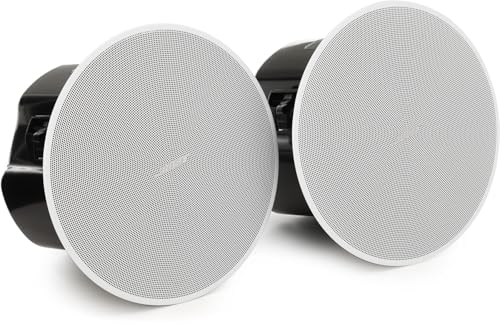
Bose Professional DesignMax DM5C 60W 5.25-inch in-Ceiling Loudspeaker - White, 1-Pair
$821.00 Specs and sizingA coaxial ceiling speaker with unusually even off-axis response, which is what makes a distributed system sound like one system rather than a row of speakers. Sold as a pair.
Best for: A ceiling system that has to carry music, not just the spoken word
Check price on Amazon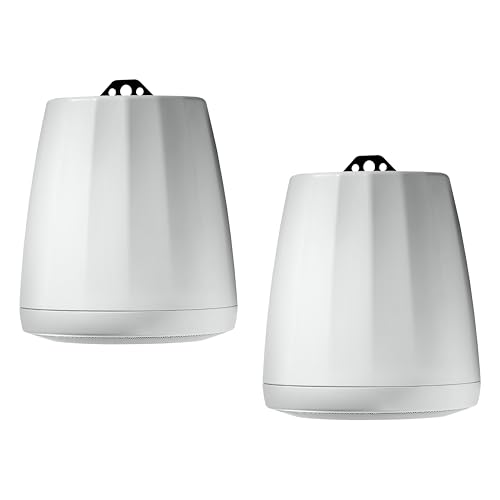
JBL Professional C65P/T-WH Compact Full-Range Hanging Pendant Speaker, 8 Ohm or 70V, 5.25-Inch. White, Sold as Pair
$550.00 Specs and sizingA hanging pendant speaker for open or exposed ceilings, where there is no grid to cut into and running speakers down from the deck is the only option.
Best for: Exposed structure ceilings, warehouses and modern open-plan auditoriums
Check price on AmazonHow we chose
We did not test these products in person and we never claim to. Picks are researched from manufacturer specification sheets and operator manuals, FCC rules where spectrum is involved, published standards, warranty terms, and the recurring themes in verified owner reviews. Every pick is matched to a real room size, seat count or input list rather than to a price bracket, and it is placed in the tier where its capability actually belongs. Where a product is wrong for most churches we say so on the page.
Sources
- Loudspeaker manufacturer application guidance on conical coverage and grid spacing
- Published coverage angle and power tap figures for the ceiling loudspeakers listed on this page
Frequently asked questions
How far apart should ceiling speakers be with a 22 foot ceiling?
About 25.5 feet apart for a typical 90 degree speaker covering seated listeners, which is the minimum-overlap layout used for speech. If the system is only for background music you can stretch to 36 feet edge to edge, and if intelligibility is critical, or the room is noisy, tighten to 18 feet.
How much area does one ceiling speaker cover at 22 feet?
A 90 degree speaker covers a circle about 36 feet across at seated ear height, which is roughly 1,018 square feet of circle. On a minimum-overlap square grid you get about 648 square feet per speaker, because the circles have to overlap to cover the corners.
Should I measure from the floor or from ear height?
From ear height, always. Coverage is a cone, so what matters is the distance from the speaker down to the listening plane, not down to the floor. Using the floor at a 22 foot ceiling over-states the coverage circle by about 22 percent, which puts every speaker too far from the next one and leaves quiet patches between seats.
Do I need more speakers for a standing congregation?
Slightly. A standing listener's ears are about 5 feet up rather than 4, so the speaker is one foot closer and the coverage circle shrinks to about 34 feet. In a room used for both, size for the seated case, which is the larger circle, and accept slightly tighter coverage when people stand.
What wattage tap should each speaker use?
For speech in a quiet room, 2 to 4 watts per speaker is usually plenty and 8 watts is loud. For music, or a room with air handling noise, step to 8 or 16 watts. Start every speaker at the same tap, listen, then raise only the ones under a noisy area. Setting every speaker to 32 watts because the amplifier can take it just means the system is loud and still poorly balanced.
Researched, not professional advice. This page is compiled from published manufacturer specifications, operator manuals, FCC rules, published standards and owner-review consensus, not hands-on testing. Sound system design, rigging loudspeakers overhead, and any electrical work are jobs for a qualified professional: have flown loudspeakers and their attachment points signed off by a structural engineer or a certified rigger, and have all wiring done by a licensed electrician to your local code. Wireless microphone rules change, so confirm the current FCC position before buying. As an Amazon Associate we earn from qualifying purchases.