Loudspeakers
70 Volt System Calculator
Quick answer
Add up every speaker tap, then divide by 0.8 to size the amplifier. Sixteen speakers at 8 watts is 128 watts of tap load, which needs a 200 watt 70 volt amplifier. That 20 percent margin covers transformer tolerance and lets you add a speaker later.
A 70 volt line is the format that makes a distributed ceiling system practical. A transformer at each speaker lets you tap a fixed wattage, and a transformer at the amplifier raises the line voltage so far less current flows, which means thin cable runs a long way to many speakers with negligible loss.
The arithmetic is deliberately simple: sum the taps, add headroom, buy the amplifier. Enter your system below.
70 volt system calculator
Amplifier size needed
70 volt amplifiers and ceiling speakers
Top matches update when you change your numbers.

Crown CDi 1000 Two-Channel, 500-Watt @ 4Ω, 70V/140V Power Amplifier
$1,487.52 Specs and sizingA true install amplifier with direct 70V and 140V outputs, so a distributed ceiling system needs no output transformer of its own.
Best for: Any 70V ceiling or distributed system
Check price on Amazon
Crown CDi 2000 Two-Channel, 800-Watt @ 4Ω, 70V/140V Power Amplifier
$1,125.00 Specs and sizingThe larger CDi, for a 70V line long enough or dense enough that 500 watts per channel runs out of tap budget.
Best for: Large distributed systems, or a 70V line shared with several ancillary rooms
Check price on Amazon
Atlas Sound AtlasIED FAP62T Strategy II 6-inch 32W 70/100V Ceiling Speaker System
$350.95 Specs and sizingA complete 70V ceiling speaker system with baffle, back can and transformer in one part number, which is why installers keep them on the truck.
Best for: A straightforward 70V distributed system with no surprises at install time
Check price on Amazon
Atlas Sound FAP40T Ceiling Speaker, 4"
The 4 inch Atlas, for the same reason as the small JBL: coverage in spaces that need to be heard rather than impressed.
Best for: Hallways, offices and small ancillary rooms on the same 70V line
Check price on Amazon
AtlasIED 8" Dual Cone in-Ceiling Speaker with 25V/70V 5-Watt Transformer and 62-8 Baffle with Volume Control
$61.74The cheapest legitimate 70V ceiling speaker with a real transformer and enclosure. A dual cone, so it is a speech speaker and not a music speaker.
Best for: Speech-only paging and overflow on a tight budget
Check price on Amazon
JBL Professional JBL-Control 416C/T 6.5” 2-Way, Coaxial, 50 Watt, in-Ceiling Speaker with Backcan, 8 Ohm or 70V / 100V, Magnetic Grill
$494.00 Specs and sizingA 50 watt coaxial ceiling speaker with the back can and a 70V transformer built in, which is the whole install in one box.
Best for: A distributed ceiling system in a low or flat-ceilinged room
Check price on Amazon
JBL Professional Control 47LP Low Profile Loudspeaker, Sold as Pair
$590.00 Specs and sizingA low-profile coaxial ceiling speaker with the back can included, so it drops into a standard grid without a separate enclosure purchase.
Best for: Suspended ceiling installs at normal ceiling heights
Check price on Amazon
JBL Professional Control 24CT 4-Inch Background/ForegroundCeiling Speaker, Black, Sold as Pair
$350.00 Specs and sizingA small 4 inch ceiling speaker for spaces that need coverage rather than impact: corridors, nurseries, restrooms and the cry room.
Best for: Paging and overflow audio in ancillary spaces
Check price on Amazon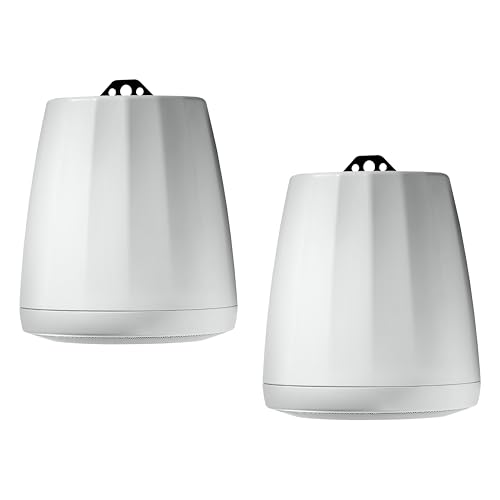
JBL Professional C65P/T-WH Compact Full-Range Hanging Pendant Speaker, 8 Ohm or 70V, 5.25-Inch. White, Sold as Pair
$550.00 Specs and sizingA hanging pendant speaker for open or exposed ceilings, where there is no grid to cut into and running speakers down from the deck is the only option.
Best for: Exposed structure ceilings, warehouses and modern open-plan auditoriums
Check price on Amazon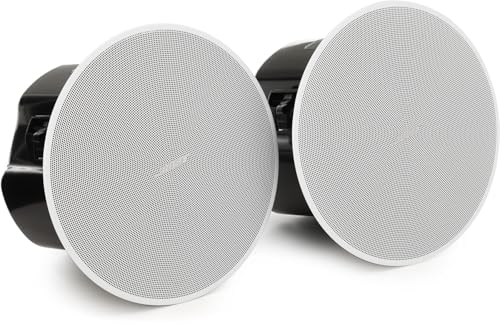
Bose Professional DesignMax DM5C 60W 5.25-inch in-Ceiling Loudspeaker - White, 1-Pair
$821.00 Specs and sizingA coaxial ceiling speaker with unusually even off-axis response, which is what makes a distributed system sound like one system rather than a row of speakers. Sold as a pair.
Best for: A ceiling system that has to carry music, not just the spoken word
Check price on Amazon
Rockville MC80 Metal 8" 70V/25V Commercial in-Ceiling Speakers, Pair
$54.95A budget 70V and 25V ceiling pair with selectable taps. Fine for a fellowship hall or a corridor, and not what should be over the congregation.
Best for: Ancillary spaces where the budget has genuinely run out
Check price on AmazonHow do you size a 70 volt amplifier?
Sum every speaker's tap setting, then divide by 0.8:
amplifier watts = total tap wattage / 0.8
The 20 percent margin is installer convention rather than a code requirement, and it covers two real things. Transformers are not perfect, so the actual load is slightly above the nameplate sum. And a church that fills its amplifier exactly has to replace it the first time somebody wants a speaker in the new nursery, which happens more often than not.
The other rule is what not to do: never exceed the amplifier's rating. Unlike a low-impedance amplifier, which simply runs out of headroom, an overloaded 70 volt amplifier is being asked to drive a load below its minimum impedance and can fail. Count carefully, and count again after anyone adds a speaker.
Amplifier size by speaker count and tap
Total tap load and the amplifier it needs, at three common tap settings. Read the pair as tap total over amplifier size.
Sixteen ceiling speakers tapped at 8 watts is 128 watts of load and needs a 200 watt 70 volt amplifier once the 80 percent rule is applied.
| Speakers | At 4 W tap | At 8 W tap | At 16 W tap |
|---|---|---|---|
| 6 speakers | 24 W / 100 W | 48 W / 100 W | 96 W / 150 W |
| 10 speakers | 40 W / 100 W | 80 W / 100 W | 160 W / 200 W |
| 16 speakers | 64 W / 100 W | 128 W / 200 W | 256 W / 400 W |
| 24 speakers | 96 W / 150 W | 192 W / 300 W | 384 W / 500 W |
| 40 speakers | 160 W / 200 W | 320 W / 400 W | 640 W / 800 W |
| 60 speakers | 240 W / 300 W | 480 W / 600 W | 960 W / 1,200 W |
Amplifier sizes are rounded up to a size that is actually sold. A 70 volt system needs an amplifier with a real 70 volt output, not a low-impedance amplifier with a transformer added.
Which tap should each speaker use?
The tap sets how much power that speaker draws and therefore how loud it is. Start everything at the same tap, walk the room, then raise only what needs it.
Four watts is the usual starting tap for speech in a normal church space, and eight watts covers a noisier room or a higher ceiling.
| Tap | Suits | Note |
|---|---|---|
| 0.5 W | Very quiet office or corridor | Rarely used in a church |
| 1 W | Quiet corridor, restroom | Background paging only |
| 2 W | Quiet room, low ceiling | Speech in a small quiet space |
| 4 W | Classroom, nursery, fellowship hall | The usual starting tap for speech |
| 8 W | Noisier room, or a higher ceiling | Speech with some background noise, or light music |
| 16 W | Music, or a noisy space | Fellowship hall with a crowd, gymnasium |
| 32 W | High ceiling with music | Rarely needed, and usually a sign the wrong speaker was chosen |
Setting every speaker to 32 watts because the amplifier can take it produces a loud system that is still badly balanced, and it consumes the amplifier budget four times faster than necessary.
When 70 volts is the right answer, and when it is not
Use 70 volts for anything above about four speakers, anything spread across a building, and any system somebody will want to extend. Adding a speaker becomes a tap setting rather than an impedance puzzle, and the cable stays thin over long runs. A distributed system in corridors, a nursery, a fellowship hall and an overflow room is exactly the case the format was designed for.
Do not use 70 volts for the main loudspeakers in a sanctuary. The transformers add cost and introduce a small amount of distortion and low frequency limitation, and none of that buys you anything when there are only two or four boxes in one room at short cable distances. Main systems run at 8 ohms into a conventional amplifier such as the Crown XLS1502 2-Channel Class D DriveCore Professional Power Amplifier with DSP, Band Pass Filters & Peak Limiters. XLR/RCA Inputs, 525W at 4 Ohm, PureBand Crossover System. Black.
For the distributed side, an amplifier with a direct 70 volt output such as the Crown CDi 1000 Two-Channel, 500-Watt @ 4Ω, 70V/140V Power Amplifier or Crown CDi 2000 Two-Channel, 800-Watt @ 4Ω, 70V/140V Power Amplifier is the correct tool, and speakers with the transformer and back can already fitted, like the Atlas Sound AtlasIED FAP62T Strategy II 6-inch 32W 70/100V Ceiling Speaker System or the JBL Professional JBL-Control 416C/T 6.5” 2-Way, Coaxial, 50 Watt, in-Ceiling Speaker with Backcan, 8 Ohm or 70V / 100V, Magnetic Grill, are the whole install in one part number. Space them with the ceiling speaker spacing calculator.
Frequently asked questions
How do I size a 70 volt amplifier?
Add up every speaker tap setting and divide by 0.8. Sixteen speakers at 8 watts each is 128 watts of load, which needs a 200 watt amplifier. The 20 percent margin covers transformer tolerance and leaves room to add a speaker later without replacing the amplifier, which is the situation almost every church eventually finds itself in.
What tap setting should ceiling speakers use?
Four watts is the usual starting point for speech in a normal church space, and eight watts suits a noisier room or a higher ceiling. Set every speaker to the same tap first, walk the room listening, then raise only the ones under a noisy area such as an air handling diffuser. Starting everything at 32 watts gives you a loud system that is still badly balanced.
When should a church use 70 volt instead of 8 ohm?
Above about four speakers, or whenever they are spread across a building. A constant voltage line lets you hang many speakers on one pair of thin wires and set each one independently with a tap, and adding a speaker later is a tap setting rather than an impedance calculation. Below four speakers in one room, plain 8 ohm wiring is simpler and slightly more efficient.
Can I use a regular amplifier for a 70 volt system?
Only with a separate step-up transformer, which adds cost, weight and distortion. A proper install amplifier with a direct 70 volt output is the right tool and usually cheaper overall. Do not connect a low-impedance amplifier straight to a 70 volt line: the transformers present a load it is not designed for.
What happens if I overload a 70 volt amplifier?
It is being asked to drive a load below its minimum impedance, which can cause it to shut down or fail rather than simply running out of headroom the way a low-impedance amplifier does. Keep the total tap load at or below 80 percent of the rating, and recount every time somebody adds a speaker, which is when most overloads happen.
Does a 70 volt system need heavy cable?
No, and that is the main reason the format exists. Raising the voltage lowers the current, and resistive loss depends on current, so 16 or 18 AWG will carry a substantial system hundreds of feet with negligible loss. The cable does still have to be rated for where it runs, which is a fire code question rather than an electrical one.
Researched, not professional advice. This page is compiled from published manufacturer specifications, operator manuals, FCC rules, published standards and owner-review consensus, not hands-on testing. Sound system design, rigging loudspeakers overhead, and any electrical work are jobs for a qualified professional: have flown loudspeakers and their attachment points signed off by a structural engineer or a certified rigger, and have all wiring done by a licensed electrician to your local code. Wireless microphone rules change, so confirm the current FCC position before buying. As an Amazon Associate we earn from qualifying purchases.