Projection and screens
Fixed Frame vs Motorized Projector Screens
Quick answer
A 150 inch fixed frame costs $575.00 against $766.95 motorized, and the extra buys the ability to make the screen disappear, not a better image. Choose fixed for a room that is only ever a sanctuary, motorized for a room that hosts weddings and concerts.
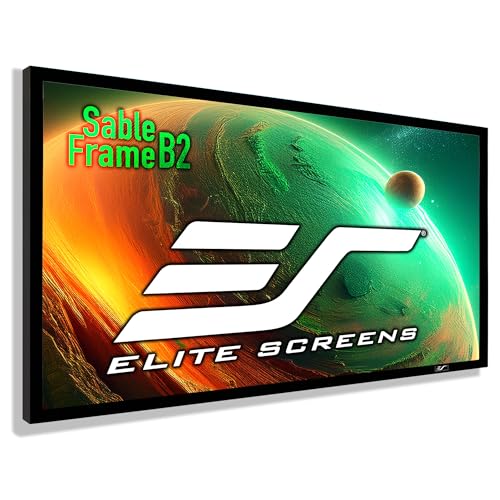
Elite Screens Sable Frame B2 150" Fixed Frame Projector Screen SB150WH2
$575.00 Specs and sizingA tensioned fixed frame with a black velvet border that absorbs overspill and makes the image edge look crisp, with no moving parts at all.
Best for: A mid-size sanctuary where the back row is 35 to 40 feet out
Check price on Amazon
Projector Screen Elite Screens Spectrum, 150-INCH Diag 16:9, Motorized Projection Screen Movie Home Theater 4K/8K Ultra HD Ready, Black Case, ELECTRIC150H2
$766.95 Specs and sizingA motorized 150 inch screen with a remote, so the screen is not a two-person job before every service in a room used for other things.
Best for: A large screen that must retract for weddings, funerals and concerts
Check price on AmazonA fixed frame screen gives a flatter surface, a crisper edge and nothing that can fail, for less money. Buy one unless the room genuinely has to do something else during the week. That is the whole decision, and the image quality argument only ever runs one way.
The case for a motorized screen is architectural rather than technical. A sanctuary that hosts weddings and funerals, a room with a cross or stained glass behind the screen position, or a hall used as a gymnasium needs the screen to vanish, and no amount of image quality compensates for a permanent screen in the wrong place. Size the screen first on the screen size calculator.
Side by side
| Model | Price | Screen diagonal | Aspect ratio | Screen gain | Material | Motorized |
|---|---|---|---|---|---|---|
| Elite Screens Sable Frame B2 150" Fixed Frame Projector Screen SB150WH2 | $575.00 | 150 in | 16:9 | 1.1 | CineWhite fixed frame | - |
| Projector Screen Elite Screens Spectrum, 150-INCH Diag 16:9, Motorized Projection Screen Movie Home Theater 4K/8K Ultra HD Ready, Black Case, ELECTRIC150H2 | $766.95 | 150 in | 16:9 | 1.1 | - | Yes |
Three screen types at 150 inches
The manual pull-down belongs in this comparison because it is what most churches are actually replacing, and because at this size it is heavier than people expect.
A 150 inch fixed frame costs $575.00 against $766.95 for the motorized version, and the extra buys the ability to make the screen disappear rather than a better image.
| Requirement | Fixed frame | Manual pull-down | Motorized |
|---|---|---|---|
| Price at 150 inches | $575.00 | $379.84 | $766.95 |
| Surface flatness | Tensioned and flat | Can wave and curl | Better than manual, not as flat as fixed |
| Black border | Yes, velvet | No | Usually not |
| Moving parts | None | A spring and a lock | A motor, a control and a circuit |
| Electrical work | None | None | A switched circuit or a low-voltage trigger |
| Suits ultra short throw | Yes | No | Not reliably |
| Room usable for other events | No, it is always there | Yes | Yes |
| Who operates it | Nobody | One strong volunteer | A remote or a wall switch |
A 150 inch manual screen is heavy and awkward, and this is the size at which a motorized screen starts to be worth the money if the screen has to move at all. Below about 120 inches a manual pull-down remains a reasonable option.
Choose a fixed frame for a room that is only a sanctuary
If the screen position is permanent, buy a fixed frame and spend the saving on the projector. The Sable Frame B2 at $575.00 gives a tensioned, genuinely flat surface, which is what keeps the geometry correct across the whole image, and a black velvet border that absorbs overspill so the edges look sharp rather than glowing. A painted wall never does either.
The absence of moving parts is worth stating plainly. There is no motor to burn out, no spring to fail, no circuit to install and nothing for a volunteer to operate before a service. In a building where the AV system has to work without an expert present, that is a feature. The 120 inch version at $352.55 suits a smaller room.
It is also the only sensible partner for an ultra short throw projector, which projects across the surface at a steep angle and shows every ripple. If your projector plan involves short throw, the screen question is already settled. See short throw against long throw.
Choose motorized when the room has to become something else
The legitimate reasons are all about the room. A sanctuary with a cross, a baptistry or stained glass behind the screen position, a multi-use hall, or a church that holds weddings and funerals where a large grey rectangle would be wrong. The Spectrum motorized screen at $766.95 retracts into its case with a remote, which is the point.
At 150 inches it is also the practical choice over a manual screen. A 150 inch pull-down at $379.84 is cheaper but heavy and awkward enough that lowering it becomes a job for one specific strong volunteer, and a screen that only one person can operate is a screen that stays down.
Plan the electrical work as part of the purchase. A motorized screen needs a switched circuit or a low-voltage trigger from the projector, installed by a licensed electrician, and it is far cheaper to do that while the wall is open than to retrofit it. Accept too that the surface will not be quite as flat as a tensioned fixed frame, and that the motor is a service item with a finite life.
Sources
- Elite Screens published Sable Frame, Manual and Spectrum specifications
Frequently asked questions
Does a fixed frame screen really look better than a pull-down?
Yes, and the difference is visible from the back row. A tensioned surface stays flat, so straight lines stay straight and text stays sharp across the whole image, while a rolled screen develops waves that distort the geometry. The black velvet border also absorbs overspill, which makes the edges read as crisp rather than glowing.
What screen gain should a church choose?
Around 1.1 for most sanctuaries, which is what the standard matte white surfaces provide. Higher gain surfaces reflect more light back toward the centre but narrow the viewing angle, which is the wrong trade in a wide church where people sit well off to the sides. Ambient light rejecting surfaces are a separate category with different rules.
Can a motorized screen be triggered by the projector?
Yes, most take a low-voltage trigger so the screen lowers when the projector powers on and retracts when it shuts down. It is worth wiring, because it removes the step a volunteer forgets. Plan the trigger cable at the same time as the power, since both are far cheaper to install before the wall is closed.
How big should the screen be for our sanctuary?
Work from the distance to the furthest seat rather than the size of the available wall. The common rules put image height between a quarter and a sixth of that distance depending on content. A 150 inch 16:9 screen is about six feet two inches high, which serves a room roughly 37 feet deep under the six times rule.
Is two smaller screens better than one large one?
Often, in a wide or fan-shaped sanctuary. Two screens placed either side of the platform keep sightlines clear and let people read without turning away from the speaker, and they avoid a single screen dominating the architecture. The cost is a second projector and keeping both images matched in brightness and colour.
Researched, not professional advice. This page is compiled from published manufacturer specifications, operator manuals, FCC rules, published standards and owner-review consensus, not hands-on testing. Sound system design, rigging loudspeakers overhead, and any electrical work are jobs for a qualified professional: have flown loudspeakers and their attachment points signed off by a structural engineer or a certified rigger, and have all wiring done by a licensed electrician to your local code. Wireless microphone rules change, so confirm the current FCC position before buying. As an Amazon Associate we earn from qualifying purchases.