Mixing consoles
Allen and Heath CQ-18T vs Behringer XR18
Quick answer
Both mixers give a church 16 preamps in three rack units, so the real question is the screen. The CQ-18T at $1,199.99 has a seven inch touchscreen on the unit itself, which means the service still runs when the tablet is missing. The XR18 at $509.00 does not.

Allen & Heath CQ-18T Digital Mixer with 7" Touchscreen WiFi and Bluetooth Connectivity
$1,199.99 Specs and sizingSixteen preamps with a seven inch touchscreen and Wi-Fi on the unit, so the mixer is usable with no tablet at all.
Best for: A 150 to 400 seat room that wants digital recall without depending on a tablet
Check price on Amazon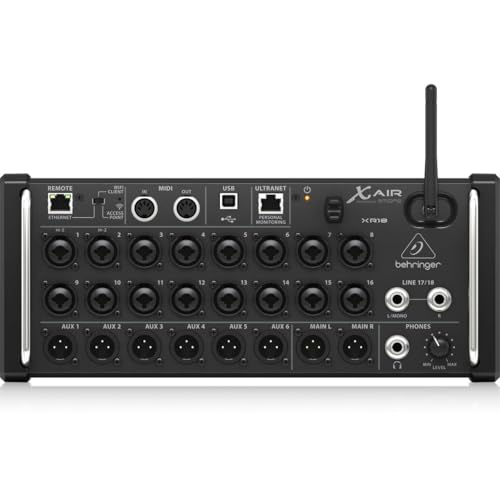
Behringer X AIR XR18 18-Channel, 12-Bus Digital Mixer for iPad/Android Tablets with 16 Programmable Midas Preamps, Integrated Wifi Module and Multi-Channel USB Audio Interface
$509.00 Specs and sizingSixteen programmable Midas preamps and 18 track USB recording at roughly 40 percent of the price, controlled entirely from a tablet.
Best for: A church plant or a 100 to 250 seat room where the mixer can stand in the congregation
Check price on AmazonIf the volunteer rota is the weak point in your church, buy the CQ-18T, because a touchscreen bolted to the mixer removes the single most common Sunday morning failure in this category. If the budget is the weak point, buy the XR18 and put a written tablet procedure on the wall.
On preamp count, rack space and channel capacity these two are near enough identical. The $1,199.99 against $509.00 difference buys an onboard interface, Allen and Heath preamps, and a set of automatic gain and feedback tools. Whether that is worth it depends entirely on who is standing at the back of your sanctuary at 9:40 on a Sunday.
Side by side
| Model | Price | Input channels | Mic preamps | Mix buses | Digital | Scene recall | Rack space |
|---|---|---|---|---|---|---|---|
| Allen & Heath CQ-18T Digital Mixer with 7" Touchscreen WiFi and Bluetooth Connectivity | $1,199.99 | 16 | 16 | 6 | Yes | Yes | 3U |
| Behringer X AIR XR18 18-Channel, 12-Bus Digital Mixer for iPad/Android Tablets with 16 Programmable Midas Preamps, Integrated Wifi Module and Multi-Channel USB Audio Interface | $509.00 | 18 | 16 | 12 | Yes | Yes | 3U |
The failure modes are different
Compare these two by what happens when something goes wrong, because that is where the price difference lives.
Every tablet-only failure mode on the XR18 ends the service, while the CQ-18T degrades to its onboard screen and keeps running.
| Failure | CQ-18T | XR18 |
|---|---|---|
| Tablet left at home | Mix from the onboard screen | No control at all |
| Tablet auto-updated overnight | Mix from the onboard screen | App may not connect |
| Wi-Fi access point dead | Mix from the onboard screen | No control at all |
| Battery flat mid-service | Mix from the onboard screen | Mix is frozen where it sat |
| Operator is brand new | Guided gain assistant | Set gain by eye |
| Mixer itself fails | Service is over | Service is over |
A frozen XR18 keeps passing audio at the last settings, so a flat tablet is survivable if the mix was already right. It is not survivable during a soundcheck.
Choose the CQ-18T if volunteers rotate weekly
Churches lose services to tablets, not to mixers. A screen on the box means the person who arrived to cover at the last minute can still bring up a channel, and the automatic gain assistant gets an inexperienced operator to a defensible starting point without understanding gain structure first. For a church with no dedicated sound person, those two things are the product.
The onboard feedback tools are the second argument, particularly for a speech-led room with a lectern microphone and hard surfaces. They do not replace correct placement, and nothing does, but they buy a few usable decibels. Our feedback guide puts that in order.
The honest trade: the CQ has fewer third party tutorials than the XR18, a smaller preset community, and no 18 track USB multitrack of the same depth. If recording every service is central, weigh that.
Choose the XR18 if the budget is the constraint
The $509.00 price is the reason this mixer is in so many churches. It buys 16 Midas preamps, six aux sends and multitrack recording for less than a single main loudspeaker, which for a church plant is exactly the right allocation. Read the church plant system guide for how that money is best spread.
It is also the better recording mixer of the two, with 18 tracks in and out over USB. A church building a podcast or an archive from the Sunday multitrack gets more from the XR18 than from the onboard screen.
Make the tablet a piece of AV equipment, not somebody personal device. Buy a dedicated tablet, turn off automatic updates, keep it on a charger in the booth, and pair a second one. Churches that do this rarely have the failures in the table above; churches that do not have them repeatedly.
Sources
- Allen and Heath published CQ series specifications
- Behringer published XR18 specifications
Frequently asked questions
Do both fit in the same rack space?
Both are three rack units deep enough for a standard shallow rack, so either drops into a booth rack or a portable case. Leave a vented unit above anything that runs warm and leave two units spare for the next thing. Size the whole rack on our rack space calculator before ordering the case.
Which has better preamps?
Allen and Heath preamps in the CQ have a slightly better published noise figure, and the difference is most visible on quiet, distant sources. On close-miked vocals and drums, both are clean and neither will be the limiting factor in a church system. Preamps are not the reason to choose between these two.
Can either one run a full band?
Sixteen preamps covers a band of about five with a drum kit, or a larger band with a shared drum overhead pair. Neither can be expanded with a stage box, so sixteen is the permanent ceiling on both. If the platform is likely to grow past that, look at the X32 Rack instead of either of these.
How many monitor mixes can each drive?
Six aux sends on the XR18 and six on the CQ-18T, which covers three or four wedge mixes plus a stream feed and an effects send. Past that you are out of buses on either. Work the count through on the monitor mix calculator before you promise every musician their own mix.
Is the CQ-18T Bluetooth useful in a church?
For walk-in music and announcements audio it is genuinely convenient, and it removes a laptop and a cable from the booth. Do not route anything critical through it. A Bluetooth connection that drops during a video is a worse problem than the cable it replaced, so keep a wired input available as the backup.
Researched, not professional advice. This page is compiled from published manufacturer specifications, operator manuals, FCC rules, published standards and owner-review consensus, not hands-on testing. Sound system design, rigging loudspeakers overhead, and any electrical work are jobs for a qualified professional: have flown loudspeakers and their attachment points signed off by a structural engineer or a certified rigger, and have all wiring done by a licensed electrician to your local code. Wireless microphone rules change, so confirm the current FCC position before buying. As an Amazon Associate we earn from qualifying purchases.