Loudspeakers
Subwoofer Sizing Calculator
Quick answer
A 250 seat church with a contemporary band needs one 12 to 15 inch subwoofer. A church of the same size running speech, hymns and a piano needs none at all, and adding one makes a small room muddier rather than fuller.
The subwoofer question is really two questions, and the first one is whether you need one at all. Subwoofers exist to reproduce content the main loudspeakers physically cannot, roughly below 60 to 80 Hz. A kick drum and a bass guitar live there. A preaching voice, a hymn and a piano largely do not.
So a speech-led church that buys a subwoofer has bought rumble. A contemporary church that does not has bought a band the congregation cannot feel. Enter your room and service style below.
Subwoofer sizing calculator
Subwoofers needed
Subwoofers that suit your room
Top matches update when you change your numbers.
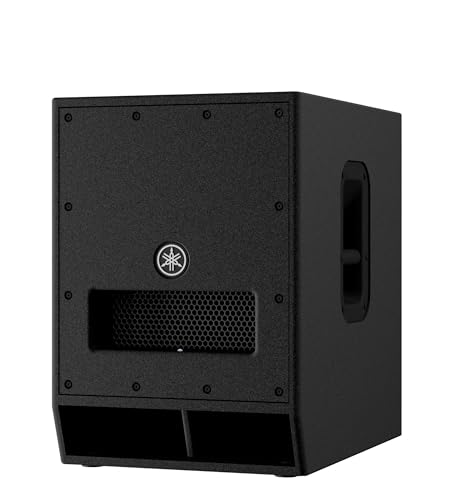
Yamaha DXS12 MKII Powered Subwoofer
$969.99 Specs and sizingYamaha processing with cardioid mode in a 12 inch cabinet light enough for one volunteer to move.
Best for: Portable setups that want low end without a two-person lift
Check price on Amazon
QSC KS112 Active 12" Subwoofer
$1,299.99 Specs and sizingA compact 12 inch subwoofer that fits under a platform or beside a riser, which is often the difference between a subwoofer existing and not.
Best for: Mid-size rooms with no floor space to spare
Check price on Amazon
Electro-Voice ELX200-18SP 18" 1200W Powered Subwoofer
$1,099.00 Specs and sizingAn 18 inch powered subwoofer with cardioid presets and fly points, at roughly half the price of the flagship options.
Best for: The first subwoofer a growing contemporary church buys
Check price on Amazon
JBL Professional PRX918XLF 18-Inch Powered Subwoofer, Portable PA, 2000 Watt, DSP, Parametric EQ, Bluetooth Low Energy (BLE), and APP Control
$1,499.00 Specs and sizingA deep-tuned 18 built for extended low frequency rather than maximum punch, with a full parametric EQ section for room correction.
Best for: Rooms with a difficult low-frequency response that needs correcting at the source
Check price on Amazon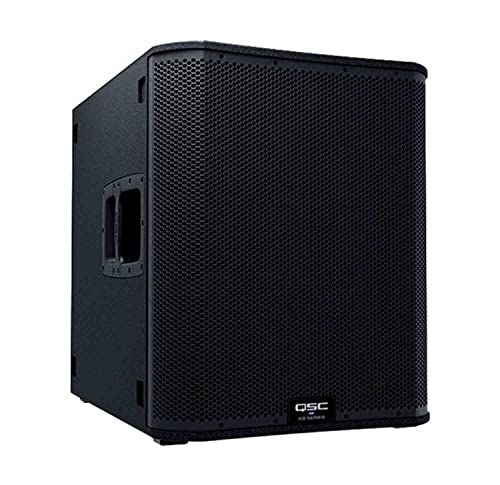
QSC KS118 Active 18" Subwoofer
$2,199.99 Specs and sizingAn 18 inch cardioid-capable subwoofer that reaches into the low thirties. The cardioid mode is the point in a church: it keeps low end off the platform and out of the open microphones.
Best for: Contemporary worship in a large room, especially where the platform booms
Check price on Amazon
JBL Professional JRX218S Portable PA, Line Array, Stage Subwoofer, 1400W Power Handling, Passive, Non-Powered, 18-Inch
$680.00 Specs and sizingA passive 18 for a system that already has amplifier channels spare. The cheapest honest route to low end if the rack has room.
Best for: Rack-amplified systems with an unused amplifier channel
Check price on Amazon
dbx DriveRack PA2 2x6 PA Complete Professional Loudspeaker Management System, Rack Mountable with Android and iOS Control. Black
$426.00 Specs and sizingCrossover, EQ, limiting, feedback suppression and an automatic room-tuning wizard in one rack unit. The wizard is the reason this is on nearly every church rack: it gets a volunteer to a defensible starting point.
Best for: Any passive system, and any room that has never been tuned
Check price on Amazon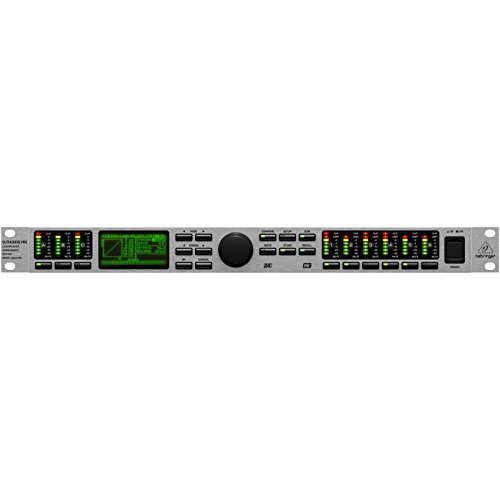
Behringer Ultradrive Pro Dcx2496 Ultra High-Precision Digital 24-Bit/96 Khz Loudspeaker Management System
$339.00 Specs and sizingA three in, six out digital loudspeaker manager with crossovers, delay and limiting on every output, which is what a delay-speaker system needs.
Best for: Systems with under-balcony or mid-room delay speakers to time-align
Check price on AmazonDoes your church need a subwoofer?
By service style, which matters far more than seat count for this particular decision.
A church running speech, hymns and a piano needs no subwoofer at all, while a contemporary worship band needs one to two and a modern full band needs two in cardioid placement.
| Service style | Subwoofers | Why |
|---|---|---|
| Speech and teaching only | None | Nothing below about 80 Hz is being reproduced. A subwoofer adds rumble and nothing else. |
| Traditional, hymns and organ | None, usually | A pipe organ produces its own low end acoustically and is rarely reinforced at all. |
| Blended, piano and small band | One, optional | Helps a kick drum and a bass guitar. Not required, and easy to overdo in a small room. |
| Contemporary worship band | One to two | The mains cannot produce the low end a kick and bass need. This is where subwoofers earn their place. |
| Modern, full band with in-ears | Two, cardioid | Weight is part of the sound. Cardioid placement keeps it out of the open microphones. |
If the only low frequency content is a pipe organ, the honest answer is almost always none: an organ produces its low end acoustically and reinforcing it usually makes the room worse.
How many subwoofers by church size?
Once you have established that the programme needs low end, the count and driver size follow from the room.
A 250 seat contemporary church needs one subwoofer and a 600 seat one needs two, while the same rooms running speech only need none regardless of size.
| Church size | Room area | Speech only | Contemporary band | Driver size |
|---|---|---|---|---|
| 75 seats | 600 sq ft | None | 1 | 12 in |
| 150 seats | 1,200 sq ft | None | 1 | 12 in |
| 250 seats | 1,875 sq ft | None | 1 | 12 in |
| 400 seats | 3,000 sq ft | None | 2 | 15 to 18 in |
| 600 seats | 4,500 sq ft | 1 | 2 | 15 to 18 in |
| 1,000 seats | 7,000 sq ft | 1 | 2 | 18 in |
Two subwoofers are not simply louder than one. Placed apart they interfere, and the room decides where the peaks and nulls land, which is why two badly placed subwoofers can sound worse than one well placed.
What cardioid placement does, and why a church wants it
A single subwoofer radiates low frequency energy in all directions, because the wavelengths involved are longer than the cabinet. That means as much low end goes backwards onto the platform as forwards into the congregation, and that is the source of a specific and very common church problem: rumble in the open microphones, a muddy vocal, and a worship team who cannot hear themselves.
A cardioid array uses two or more drivers with deliberate delay and polarity so the energy cancels behind the array and reinforces in front of it. Typical rejection is 15 to 20 dB to the rear, which is the difference between a platform that booms and one that does not. Cabinets such as the QSC KS118 Active 18" Subwoofer and the Yamaha DXS12 MKII Powered Subwoofer have cardioid presets built in and need only correct placement to use them.
For a church this is usually worth more than the extra low frequency extension a larger cabinet would buy. The congregation rarely complains that the kick drum is not deep enough. They complain that they cannot understand the words.
Crossover, and the mistake that wastes the purchase
A subwoofer only helps if the mains stop trying to reproduce the same content. Set a crossover, typically between 80 and 120 Hz, so the subwoofer takes everything below it and the mains take everything above. Without that, the mains are still working hard on frequencies they handle badly, and the two sources overlap and cancel unpredictably.
Most powered subwoofers have a crossover built in with a high-pass output that feeds the mains, which is the simplest way to do it correctly. On a passive system, a loudspeaker processor such as the dbx DriveRack PA2 2x6 PA Complete Professional Loudspeaker Management System, Rack Mountable with Android and iOS Control. Black handles the crossover, the limiting and the alignment together.
The other half of the setup is polarity and delay: the subwoofer and the mains must arrive in phase at the listener or they cancel exactly where they overlap. That alignment is the single most common thing an integrator fixes on a system a church installed itself.
Frequently asked questions
Does a church need a subwoofer?
Only if the programme produces content below about 80 Hz, which in practice means a kick drum and a bass guitar. A church running speech, hymns, a piano and an organ does not need one, and adding one to a small room usually makes it muddier rather than fuller. A contemporary worship band genuinely does need one, because the main speakers cannot reproduce that content.
How many subwoofers does a church need?
One for a contemporary band in a room up to about 400 seats, and two above that. Two is not simply louder: placed apart they interfere and the room decides where the peaks and nulls fall, so two badly placed subwoofers can sound worse than one well placed. A centred pair or a cardioid array is the most predictable arrangement.
What size subwoofer does a church need?
A 12 inch cabinet suits rooms up to about 250 seats and has the practical advantage of being light enough for one person to move. From 250 to 600 seats a 15 or 18 inch is appropriate, and above that an 18 inch. Larger drivers reach lower rather than simply playing louder, so the choice is about how deep the programme goes.
What is a cardioid subwoofer and is it worth it in a church?
A cardioid array uses multiple drivers with deliberate delay and polarity so low frequency energy cancels behind the array and reinforces in front, typically 15 to 20 dB of rear rejection. In a church that means less rumble on the platform and therefore less in the open microphones, a clearer vocal and a happier worship team. For most churches that is worth more than extra extension.
Where should a church subwoofer go?
Near the centre of the platform in most rooms, either as a centred pair or a cardioid array. Avoid corners, which reinforce unevenly so some notes boom and others disappear, and avoid splitting a pair to opposite sides of a wide platform, which causes interference across the seating. Listen from several seats before anything is fixed in place.
Do I need a crossover with a subwoofer?
Yes, and skipping it wastes the purchase. Set a crossover between 80 and 120 Hz so the subwoofer takes everything below and the mains take everything above. Without it the mains keep working on frequencies they handle badly and the two sources overlap unpredictably. Most powered subwoofers include a crossover with a high-pass output for the mains.
Researched, not professional advice. This page is compiled from published manufacturer specifications, operator manuals, FCC rules, published standards and owner-review consensus, not hands-on testing. Sound system design, rigging loudspeakers overhead, and any electrical work are jobs for a qualified professional: have flown loudspeakers and their attachment points signed off by a structural engineer or a certified rigger, and have all wiring done by a licensed electrician to your local code. Wireless microphone rules change, so confirm the current FCC position before buying. As an Amazon Associate we earn from qualifying purchases.