Legal bands
VHF Wireless Microphones: 169 to 216 MHz
Quick answer
VHF wireless microphones at 169 to 216 MHz are legal and unlicensed in the United States under Part 15. They are the cheapest systems sold, and the trade is a crowded band shared with business radio and TV channels 7 to 13, plus a quarter-wave antenna about 16 inches long.
VHF is where the forty dollar wireless microphone lives, and it is legal, which is the first thing worth saying because so much of the wireless conversation in churches is about what is not. Nothing about a VHF system is against the rules. The problem is physics and neighbours, not law. Before you buy anything in this range, count the channels you actually need with the wireless microphone channel calculator, then read which frequencies are legal so you can compare VHF against the alternatives on the same terms. Everything below is researched from the FCC rules and published manufacturer specifications.
On this page
What is actually in the 169 to 216 MHz range?
VHF is not one band. It is two very different pieces of spectrum with different neighbours, and a cheap system will land in either without telling you which. The lower segment is a narrow set of frequencies shared with a great deal of low power business and telemetry traffic. The upper segment is VHF television, channels 7 through 13, and in a market where those channels are still on the air a microphone sitting on one of them will be swamped.
Both halves of the VHF range are legal for unlicensed church use, but only 174 to 216 MHz offers enough width for more than two or three channels.
| Range | What else is there | Status for a church | Practical channel count |
|---|---|---|---|
| 169 to 172 MHz | Low power business, telemetry and hydrological services | Legal, unlicensed, low power | 1 to 2 |
| 174 to 216 MHz | VHF television channels 7 to 13 | Legal, unlicensed, subject to local TV | 2 to 4 in a clear market |
| Between the two | Government and mobile allocations | Not available to microphones | 0 |
Neither segment carries interference protection. Unlicensed operation under Part 15 means you must accept whatever interference arrives and stop causing any you produce, whoever was there first.
Why VHF is called antenna-hungry
An antenna wants to be a sensible fraction of a wavelength, and wavelength is set by frequency. At 174 MHz a quarter wave is about 16 inches. At 550 MHz, in the middle of the UHF working band, it is about 5 inches. That is the whole story behind the phrase. A receiver with a stub antenna long enough to work properly at VHF looks absurd on a shelf, so manufacturers fit short ones and accept the loss, and the loss shows up as range and dropouts rather than as a number on the box.
The same physics runs the other way and is the one genuine VHF advantage: long wavelengths bend around obstacles better than short ones. A VHF signal will get through a plaster wall and around a pillar more happily than a 2.4 GHz signal will. If your building is a difficult shape and you need exactly one channel, that is a real point in its favour. It is not enough of a point to build a system on.
How many VHF channels can a church actually run?
Two or three, honestly, and four only in a quiet market with a system whose tuning is properly frequency agile rather than crystal fixed. Compare that with the UHF working band, where the arithmetic is far kinder because there is far more room.
VHF realistically supports two to four channels, against roughly 92 for analog UHF across a fully open 470 to 608 MHz band.
| Band | Legal status | Realistic channels in one building | Typical indoor range |
|---|---|---|---|
| VHF 169 to 216 MHz | Legal, unlicensed | 2 to 4 | 100 to 200 feet, obstacle tolerant |
| UHF 470 to 608 MHz | Legal, Part 15 or Part 74 | 6 to 20, set by open TV channels | 200 to 300 feet |
| 902 to 928 MHz ISM | Legal, unlicensed | 4 to 8 | 150 to 250 feet |
| 2.4 GHz ISM | Legal, unlicensed | 4 to 8 | About 100 feet, line of sight preferred |
Ranges are published manufacturer figures for line of sight and are optimistic in a building with a steel roof deck, a glass booth or a block wall between transmitter and receiver.
What to buy instead, and the one case for buying VHF
If you are buying new, buy UHF or buy 2.4 GHz. Both cost more than the cheapest VHF systems and both will still be working in five years. The single honest case for VHF is a portable church that needs one speaking channel in a rented room and owns nothing else: a single VHF channel in a school gymnasium is very hard to break. Everything else points the other way. For the full shortlist see wireless microphones for small churches.

Audio-Technica ATW-1102 Wireless Handheld Microphone System
$349.95 Specs and sizingA 2.4 GHz digital system with automatic frequency selection, at a price close to the better VHF systems. It is legal everywhere, it needs no coordination and it is not affected by any future television auction.
Best for: A church replacing one or two ageing VHF channels
Check price on Amazon
Sennheiser Pro Audio XSW 1-825-A Vocal Wireless Microphone, A Range 548-572 MHz, Black, medium
$329.00 Specs and sizingA 24 MHz UHF tuning range with an automatic setup that finds a clear frequency without anyone reading a manual. Ten compatible channels is far more headroom than a VHF system will ever offer.
Best for: A small church that wants room to add a third and fourth channel later
Check price on Amazon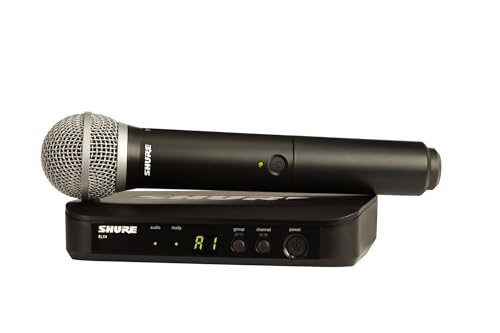
Shure BLX24/PG58 Wireless Vocal Microphone System - H10 Band
$329.00 Specs and sizingThe cheapest Shure UHF system, on the same BLX4 receiver as the more expensive versions, so a later capsule upgrade costs a capsule rather than a channel.
Best for: A first proper wireless channel for announcements and a roaming speaker
Check price on AmazonWhat usually goes wrong with VHF in a church
Three failures repeat. The first is a crystal fixed system, where the frequency cannot be changed at all, so when a neighbouring business radio or a returning TV signal lands on top of it the only fix is a new system. The second is antenna placement, which matters more here than anywhere: a short whip behind a closed metal rack door at VHF is barely an antenna at all. The third is buying a second and third channel from a different brand, because two unrelated systems have no idea where each other are sitting and will happily be assigned frequencies that beat against each other.
If the symptom is hiss and noise rather than dropouts, the problem is usually gain structure rather than radio. Walk it through with gain structure for church sound before you replace anything. If the symptom is squealing when the speaker walks forward, that is feedback, and no change of band will fix it.
How we chose
We did not test these products in person and we never claim to. Picks are researched from manufacturer specification sheets and operator manuals, FCC rules where spectrum is involved, published standards, warranty terms, and the recurring themes in verified owner reviews. Every pick is matched to a real room size, seat count or input list rather than to a price bracket, and it is placed in the tier where its capability actually belongs. Where a product is wrong for most churches we say so on the page.
Sources
- FCC guidance for wireless microphone users
- FCC Part 15 rules for low power wireless microphones
- Published manufacturer specifications for Shure, Sennheiser and Audio-Technica entry wireless systems
Frequently asked questions
Are VHF wireless microphones still legal in the United States?
Yes. The 169 to 216 MHz range was untouched by the 600 MHz incentive auction, and wireless microphones operate there unlicensed under Part 15. Legality is not the issue with VHF. The issues are a crowded band, long antennas for the wavelength and a realistic ceiling of about two to four channels in one building, which is why almost no new church system is built on it.
How many VHF wireless microphones can I use at once?
Two or three reliably, and four only in a quiet market with frequency agile systems from the same manufacturer. Crystal fixed systems are worse, because the frequencies cannot be moved to avoid each other. Compare that with the UHF band, where four compatible analog channels fit inside a single 6 MHz television channel and a clear market may offer several such channels.
Why does my VHF microphone drop out when the pastor walks behind a pillar?
Usually the receiver antenna rather than the transmitter. A quarter-wave antenna at 174 MHz wants to be about 16 inches long, and most receivers ship with something much shorter, which costs sensitivity. Get both antennas out from behind a closed rack door, give them line of sight to the platform, and separate them by a foot or so if the receiver has two.
Is VHF better than 2.4 GHz for a difficult building?
For a single channel through solid obstacles, sometimes yes. Long wavelengths diffract around pillars and through plaster better than short ones. The advantage disappears as soon as you want a second or third channel, because VHF has very little room and 2.4 GHz systems coordinate themselves. For most churches the tie-breaker is channel count, and that points at UHF.
Should we replace our working VHF system?
Not on legal grounds, because nothing about it is prohibited. Replace it when it stops being reliable, when you need a third or fourth channel, or when a spare part is no longer available. If you do replace it, move to UHF for channel count or to 2.4 GHz to be free of frequency coordination altogether, and budget per channel rather than per system.
Do we need an FCC licence to use VHF microphones?
No. Church VHF systems operate unlicensed, which means low power limits and no protection from interference. Part 74 licensing exists but its eligibility rules do not cover a typical congregation, and a licence would not make VHF less crowded anyway. See the licensing page for who actually qualifies and what a licence buys.
Researched, not professional advice. This page is compiled from published manufacturer specifications, operator manuals, FCC rules, published standards and owner-review consensus, not hands-on testing. Sound system design, rigging loudspeakers overhead, and any electrical work are jobs for a qualified professional: have flown loudspeakers and their attachment points signed off by a structural engineer or a certified rigger, and have all wiring done by a licensed electrician to your local code. Wireless microphone rules change, so confirm the current FCC position before buying. As an Amazon Associate we earn from qualifying purchases.