Screen size by room depth
What Size Projection Screen for a 100 Foot Sanctuary?
Quick answer
In a 100 foot deep sanctuary the furthest seat is about 92 feet from the screen. For lyrics and sermon points the six times rule applies, so the image needs to be at least 15.3 feet high, which is 27.3 feet wide or about a 375 inch diagonal in 16 by 9. The bottom of the image should sit at least 4 feet off the floor.
Screen size in a sanctuary is decided by the back row, not by the wall. The standard is the four, six and eight times rule, which sets how far the furthest viewer can sit expressed in screen heights: four heights for fine detail, six for the text and lyrics a church actually projects, and eight for video and images only. In a 100 foot room, allowing for the platform, the furthest seat sits around 92 feet out, and that is the number the screen is sized from.
On this page
How big should the screen be in a 100 foot sanctuary?
The same room under all three viewing rules. Pick the row that matches what you put on screen: a church projecting song lyrics and scripture is squarely in the basic row, and a church that also shows small text such as announcements or giving details should move up to analytical.
A 100 foot deep sanctuary needs a screen at least 15.3 feet high, about a 375 inch 16 by 9 diagonal, for lyrics and sermon points to be readable from the back row.
| What you project | Rule | Minimum height | Width (16:9) | Diagonal |
|---|---|---|---|---|
| Fine detail and small text | 4x height | 23 ft | 40.9 ft | 563 in |
| Lyrics, sermon points, scripture | 6x height | 15.3 ft | 27.3 ft | 375 in |
| Video and images only | 8x height | 11.5 ft | 20.4 ft | 281 in |
Which standard screen sizes work in this room?
Screens are sold in standard diagonals, so the practical question is which stock size clears the requirement. The last column applies the six times rule to each one.
The smallest standard screen that works in a 100 foot sanctuary is larger than 200 inches.
| Diagonal | Width | Height | Serves a back row at | Works here |
|---|---|---|---|---|
| 100 in | 7.3 ft | 4.1 ft | 25 ft | Too small |
| 120 in | 8.7 ft | 4.9 ft | 29 ft | Too small |
| 135 in | 9.8 ft | 5.5 ft | 33 ft | Too small |
| 150 in | 10.9 ft | 6.1 ft | 37 ft | Too small |
| 180 in | 13.1 ft | 7.4 ft | 44 ft | Too small |
| 200 in | 14.5 ft | 8.2 ft | 49 ft | Too small |
Two screens side by side are common in wide rooms and do not change this arithmetic: each screen still has to be big enough on its own for the people watching it.
The two mounting rules that matter more than the size
Bottom of image at least 4 feet off the floor. Below that, the heads in the rows in front block the bottom of the screen for everyone behind, which is where the lyrics are. In a room with a flat floor, go higher.
Nearest seat no closer than about 1.5 screen widths. For a 27.3 foot wide image that is 41 feet, so the front rows of a 100 foot room will be inside that distance and the people there will have to look up and across. That is normal and it is why the front two rows are the last to fill.
Getting both right often means the screen cannot go where the architecture wants it. A short-throw or ultra short-throw projector solves the related problem of people walking through the beam, and an ambient-light-rejecting screen solves the problem of a room whose lights never come down.
How bright does the projector need to be for this screen?
A 27.3 by 15.3 foot image is about 418 square feet. Under normal service lighting, aiming at 35 foot-lamberts on a 1.1 gain screen, that needs roughly 13,299 lumens, so buy a projector rated 13,500 ANSI lumens or more. Work through the other lighting conditions on the projector brightness pages or in the lumens calculator.
Screens around 375 inches
Fixed frame screens look best and never wrinkle. A motorized screen costs more and is what a shared sanctuary actually needs, because a 150 inch manual pull-down is a two-person job before every service.

Projector Screen Elite Screens Spectrum, 150-INCH Diag 16:9, Motorized Projection Screen Movie Home Theater 4K/8K Ultra HD Ready, Black Case, ELECTRIC150H2
$766.95 Specs and sizingA motorized 150 inch screen with a remote, which is what a large shared sanctuary actually needs so the screen is not a two-person job before every service.
Best for: A large screen that must retract for weddings, funerals and concerts
Check price on Amazon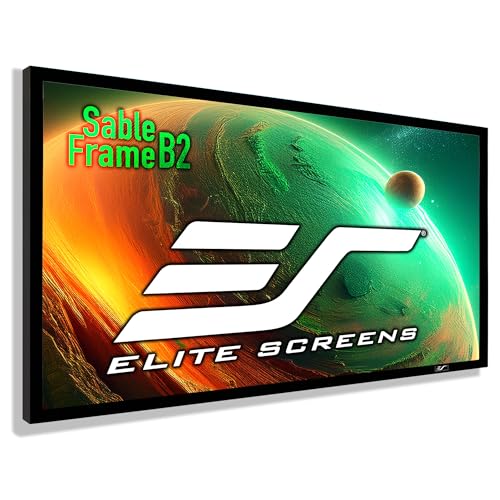
Elite Screens Sable Frame B2 150" Fixed Frame Projector Screen SB150WH2
$575.00 Specs and sizingThe same fixed frame at 150 inches, which is roughly a 6 foot 2 inch image height and serves a room about 37 feet deep under the six times rule.
Best for: A mid-size sanctuary where the back row is 35 to 40 feet out
Check price on Amazon
Elite Screens 150-Inch ALR Projector Screen 16:9 – Ceiling & Ambient Light Rejecting, Fixed Frame Wall Mounted, ISF-Certified CineGrey 3D for Home Theater, Standard Throw Projectors, ER150DHD3
$858.53An ambient light rejecting surface that reflects the projector and absorbs light from above. In a room with windows this does more for contrast than another 2,000 lumens would.
Best for: Sanctuaries with clerestory windows or lighting that cannot come down
Check price on Amazon
Elite Screens Manual Series, 150-INCH 16:9, Pull Down Manual Projector Screen with AUTO LOCK, Movie Home Theater 8K / 4K Ultra HD 3D Ready, 2-YEAR WARRANTY, M150UWH2
$379.84 Specs and sizingThe 150 inch pull-down. At this size a manual screen is heavy and awkward, and it is the point where a motorized screen starts to be worth the money.
Best for: A large image in a shared room, if someone strong is on the rota
Check price on AmazonHow we chose
We did not test these products in person and we never claim to. Picks are researched from manufacturer specification sheets and operator manuals, FCC rules where spectrum is involved, published standards, warranty terms, and the recurring themes in verified owner reviews. Every pick is matched to a real room size, seat count or input list rather than to a price bracket, and it is placed in the tier where its capability actually belongs. Where a product is wrong for most churches we say so on the page.
Sources
- AV industry viewing distance guidance, the four, six and eight times screen height rule
- Manufacturer published dimensions and gain figures for the projection screens listed
Frequently asked questions
What size screen do I need for a 100 foot church?
At least 15.3 feet high and 27.3 feet wide, which is about a 375 inch 16 by 9 diagonal. That comes from the six times rule with a furthest seat about 92 feet from the screen. Go larger if you project small text such as announcements or giving information, because that pushes you into the four times rule instead.
What is the four, six and eight times rule?
It sets the furthest acceptable viewing distance as a multiple of the screen height. Four times the height for analytical detail such as spreadsheets and fine print, six times for basic decision making, which is where song lyrics and sermon points sit, and eight times for passive viewing of video and images only. Divide your furthest seat distance by the multiple to get the minimum screen height.
How high should a church projection screen be mounted?
The bottom of the image should be at least 4 feet above the floor so that heads in the rows in front do not block it, and higher still on a flat floor. Balance that against neck strain in the front rows: the top of the image should not force the nearest seats to look up more than about 35 degrees.
Is one big screen or two smaller screens better?
Two screens flanking the platform keep the congregation looking forward and work well in a wide fan-shaped room. One central screen is simpler, cheaper and better where the room is narrow and deep. Each screen still has to satisfy the six times rule on its own for the people who are actually watching it, so two small screens do not add up to one big one.
Does a 4:3 screen still make sense for a church?
Rarely now. Almost all presentation software, video and camera output is 16 by 9, and projecting 16 by 9 content on a 4:3 screen wastes the top and bottom of the screen you paid for. The exception is a church with a large library of older 4:3 material it genuinely still uses every week.
Researched, not professional advice. This page is compiled from published manufacturer specifications, operator manuals, FCC rules, published standards and owner-review consensus, not hands-on testing. Sound system design, rigging loudspeakers overhead, and any electrical work are jobs for a qualified professional: have flown loudspeakers and their attachment points signed off by a structural engineer or a certified rigger, and have all wiring done by a licensed electrician to your local code. Wireless microphone rules change, so confirm the current FCC position before buying. As an Amazon Associate we earn from qualifying purchases.