Room and accessibility
Acoustic Treatment Calculator
Quick answer
A hard-surfaced 250 seat sanctuary typically measures around 2.0 seconds of reverberation, against a target of 0.8 to 1.2 seconds for a contemporary service. Closing that gap usually takes 40 to 70 two inch panels, and no loudspeaker purchase substitutes for it.
This is the calculator that most often tells a church not to spend money on equipment. If the room rings, every loudspeaker in it is fighting the reflections, and adding power makes the reflections louder too. Reverberation is the one problem no amplifier, console or speaker fixes.
The estimate below uses the Sabine equation, which is an approximation and a good one for deciding whether you have a problem. Before spending real money, get the room measured: a professional measurement costs a fraction of a system and frequently changes what you buy.
Acoustic treatment calculator
Estimated reverberation time
Acoustic treatment for your room
Top matches update when you change your numbers.

Auralex Studiofoam Wedge Panels, 2-Inch by 24-Inch by 24-Inch, Pack of 2
$58.99Two inch foam, which is genuinely effective above roughly 500 Hz and does almost nothing below it. Useful on a rear wall slap, useless against a boomy room, and it is worth saying so.
Best for: A specific slapback off a rear or side wall
Check price on Amazon
Auralex 2 inch Studiofoam Wedgies 1x1 foot Acoustic Panel 24-pack with Bass Trap 4-pack
$356.98Enough panels to treat a small room properly, with four bass traps for the corners where the low frequency energy actually collects.
Best for: A recording room, a green room or a small chapel with a slap problem
Check price on Amazon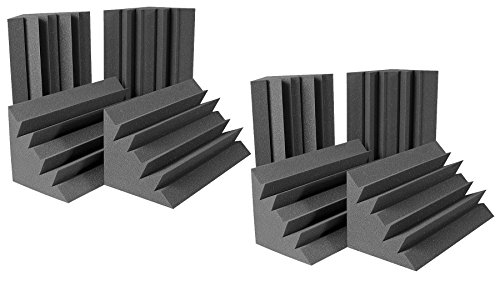
Auralex Acoustics LENCHA LENRD Acoustic Absorption Bass Traps, 24" x 12" x 12", 8 Pack
$374.99Corner bass traps, which do the job flat panels cannot. In a sanctuary the low-frequency build-up in the corners is usually what makes the band sound muddy at the back.
Best for: Room corners, before spending anything on more flat panels
Check price on AmazonWhat reverberation time should a church aim for?
There is no single right answer, because speech and music want opposite things. A room tuned for a pipe organ is a bad room for the spoken word, and that trade is real rather than a matter of equipment.
A contemporary worship service wants a reverberation time of 0.8 to 1.2 seconds, while a traditional choir and organ service wants 1.6 to 2.4 seconds, which is why one room rarely serves both well.
| Service style | RT60 target | What it trades |
|---|---|---|
| Speech and teaching | 0.6 to 0.9 seconds | Intelligibility dominates |
| Contemporary worship band | 0.8 to 1.2 seconds | A compromise, and it is a real one |
| Blended service | 1 to 1.4 seconds | A compromise, and it is a real one |
| Choir, organ and hymns | 1.6 to 2.4 seconds | Music benefits, speech suffers |
A blended church usually has to choose. The honest compromise is to treat toward the speech end and let the sound system carry the music, because an unintelligible sermon is a worse outcome than a slightly dry hymn.
What is a typical church sanctuary measuring?
Estimated with the Sabine equation for two common surface conditions: a hard room of plaster, block and wood, and one with carpet and upholstered seating.
A hard-surfaced 400 seat sanctuary typically estimates around 2.5 seconds of reverberation, roughly twice the 1.2 second target for a contemporary service.
| Church size | Volume | Ceiling | Hard surfaces | Carpet and upholstery |
|---|---|---|---|---|
| 100 seats | 10,240 cu ft | 16 ft | 1.8 s | 0.8 s |
| 200 seats | 21,600 cu ft | 18 ft | 2.2 s | 1 s |
| 400 seats | 50,400 cu ft | 21 ft | 2.8 s | 1.3 s |
| 600 seats | 86,400 cu ft | 24 ft | 3.4 s | 1.5 s |
| 1,000 seats | 151,200 cu ft | 27 ft | 4 s | 1.8 s |
Volume matters more than floor area, which is why a high ceiling is the single biggest predictor of a difficult room. Doubling the ceiling height roughly doubles the reverberation time.
What actually absorbs sound, and what only looks like it does
Absorption coefficients, roughly at 500 Hz. The number is the fraction of energy absorbed, so 1.00 is total absorption and 0.05 is a mirror.
A congregation absorbs more sound than almost any building material, at 0.4 to 0.5 per person, which is why an empty sanctuary sounds dramatically different from a full one.
| Surface | Absorption at 500 Hz | What it actually does |
|---|---|---|
| Painted plaster or block wall | 0.02 to 0.05 | Effectively a mirror. This is what most sanctuaries are made of. |
| Glass window | 0.03 to 0.08 | Reflective and usually large. |
| Wood panelling on battens | 0.10 to 0.25 | Absorbs some low mid, reflects the rest. |
| Carpet on concrete | 0.02 to 0.35 | Absorbs high frequency only. Does nothing for the low end that causes boom. |
| Upholstered pew or seat | 0.30 to 0.60 | Significant, and it is why a full room sounds different from an empty one. |
| People, per person | 0.40 to 0.50 | A congregation is the largest single absorber in most churches. |
| 2 inch fabric-wrapped fiberglass panel | 0.70 to 1.00 | Effective above roughly 250 Hz. |
| 4 inch panel or corner bass trap | 0.85 to 1.15 | The only thing here that works meaningfully below 250 Hz. |
| 2 inch acoustic foam | 0.30 to 0.85 | Effective above about 500 Hz and almost useless below it. |
Carpet is the most commonly overestimated treatment in churches. It absorbs high frequency effectively and does nothing at all for the low and low-mid energy that makes a room boom.
Where to put the treatment
- Corners first. Low frequency energy collects where surfaces meet. Corner traps do work that no amount of flat panel on a wall can, and they are usually the highest-value first purchase.
- The rear wall. The rear wall sends a distinct slapback straight back at the platform and the microphones. Treating it improves gain before feedback as well as intelligibility.
- First reflection points on the side walls. Find them by having somebody slide a mirror along the wall while you sit in a seat: where you can see a loudspeaker in the mirror, that is a first reflection point.
- The ceiling above the platform. A hard ceiling over the platform reflects the band back into the open microphones. This is often what makes a platform impossible to mix.
- Stop before the room is dead. Over-treating is a real and expensive mistake. A congregation singing in a completely dead room sounds thin and feels self-conscious, and people stop singing. Treat, listen, then treat more if needed.
Frequently asked questions
What is a good reverberation time for a church?
It depends on what the room is mostly used for. Speech and teaching want 0.6 to 0.9 seconds, a contemporary worship band 0.8 to 1.2, a blended service 1.0 to 1.4, and a choir and organ 1.6 to 2.4. One room rarely serves both ends well, and a blended church usually has to choose which it optimises for.
Will acoustic treatment fix our sound system?
It will fix problems no sound system can. If the room rings, the loudspeakers are competing with reflections of themselves and adding power makes the reflections louder too. Treatment improves intelligibility, gain before feedback and the ability to mix at all. What it will not fix is inadequate coverage, which is a loudspeaker placement problem.
How many acoustic panels does a church need?
A hard-surfaced 250 seat sanctuary moving from about 2.0 seconds to 1.2 seconds typically needs 40 to 70 two inch panels, which is roughly 320 to 560 square feet. That is a wide range because it depends entirely on the existing surfaces. The calculator gives an estimate; a professional measurement gives an answer.
Does carpet help a church acoustically?
Less than people expect. Carpet absorbs high frequency effectively and does essentially nothing for the low and low-mid energy that makes a room boom, so a carpeted sanctuary can sound both dull and muddy. Upholstered seating does considerably more, and the congregation itself is the largest absorber in most churches at 0.4 to 0.5 per person.
Is acoustic foam worth buying?
For a specific slapback off a rear or side wall, yes. As general room treatment, no. Two inch foam is effective above roughly 500 Hz and nearly useless below it, so covering a room in it removes the brightness while leaving the boom, which is the worst of both outcomes. Thicker fabric-wrapped panels and corner traps do the work that actually matters.
Can a room be over-treated?
Yes, and it is an expensive mistake to reverse. A completely dead room makes a congregation singing together sound thin and feel exposed, and people sing less as a result. Some liveness is part of what makes corporate singing work. Treat in stages, listen with the room full, and stop when speech is clear rather than when the room is silent.
Researched, not professional advice. This page is compiled from published manufacturer specifications, operator manuals, FCC rules, published standards and owner-review consensus, not hands-on testing. Sound system design, rigging loudspeakers overhead, and any electrical work are jobs for a qualified professional: have flown loudspeakers and their attachment points signed off by a structural engineer or a certified rigger, and have all wiring done by a licensed electrician to your local code. Wireless microphone rules change, so confirm the current FCC position before buying. As an Amazon Associate we earn from qualifying purchases.